Physics · Ch 10 — Magnetic Fields due to Electric Current
Magnetic Potential Energy of a Dipole
Magnetic Potential Energy of a Dipole
Section 10.8 established a direct structural analogy between a magnetic dipole's torque, , and an electric dipole's torque, (from Class XI). That same analogy extends naturally to POTENTIAL ENERGY. A freely-suspended magnetic dipole, like a freely-suspended electric dipole, possesses potential energy purely on account of its ORIENTATION within the external field -- work must be done to rotate it away from its preferred (lowest-energy) alignment, and that work is stored as potential energy which can, in principle, be released again as the dipole is allowed to swing back.
Recall that, for an electric dipole in an external field , the potential energy due to orientation is
(Class XII, Chapter 8, Electrostatics). By direct analogy, the magnetic potential energy of a magnetic dipole in an external magnetic field is
where is the angle between and . …
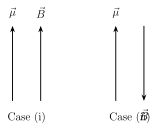
Drawn by us to help you understand the concept clearly, and verified to make sure it's accurate. For exams, practice from your textbook's own diagram.
What this figure shows. Two side-by-side sketches, labelled Case (i) and Case (ii), each showing a small magnetic dipole (drawn as a compact current loop or bar-magnet-like symbol with its moment vector , i.e. P, marked) placed within a uniform external magnetic field (drawn as a set of parallel field lines/arrows). In Case (i), the dipole's moment vector is drawn exactly PARALLEL to (pointing the same way as) the field lines of B -- the configuration of minimum potential energy, . In Case (ii), the dipole's moment vector is drawn exactly ANTI-PARALLEL to (pointing opposite to) the field lines of B -- the configuration of maximum potential energy, . The two panels together visually contrast the two extreme (most stable and least stable …