Physics · Ch 10 — Magnetic Fields due to Electric Current
Torque on a Current Loop
Torque on a Current Loop
Section 10.6 showed that a current loop in a UNIFORM magnetic field experiences zero net force, but can still experience a net TORQUE, since different segments of the loop experience forces acting along different lines. This section works out that torque explicitly for the practically important case of a rectangular current loop, and along the way arrives at the working principle of the electric motor (already met qualitatively in Class X).
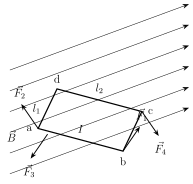
Consider a rectangular current-carrying loop , of sides (the sides and ) and (the sides and ), carrying current , placed in a uniform field oriented so that sides and are PERPENDICULAR to (Fig. 10.11), while the other pair of sides, and , are tilted at some angle to (equivalently, the loop's own normal direction makes angle with , as shown in the side view of Fig. 10.12).
Applying the straight-wire force law to each of the four sides in turn: the forces on sides and (labelled and respectively) have magnitude each, and turn out to be equal in magnitude but OPPOSITE in direction, AND to act along exactly the SAME line through the centre of the loop -- so they cancel each other completely and contribute nothing to either the net force or the net torque. The forces on the other pair of sides, and (labelled and ), each have magnitude (since these sides ARE exactly perpendicular to ). These two forces are also equal and opposite, so they too produce zero NET force -- but crucially, they act along two DIFFERENT parallel lines, separated by a perpendicular (moment-arm) distance of between them. Two equal, opposite, and non-collinear forces of this kind form a "couple," and produce a net TORQUE about the central axis of the loop equal to force times moment arm, summed for both forces (each contributing half the total moment arm on its own side of the axis):
If the loop is not a single turn but a flat coil of identical turns, each turn contributes this same torque, so the TOTAL torque is simply times as large:
…
Drawn by us to help you understand the concept clearly, and verified to make sure it's accurate. For exams, practice from your textbook's own diagram.
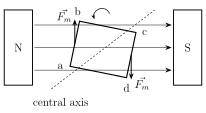
What this figure shows. A rectangular current-carrying loop abcd is shown suspended in a uniform magnetic field, with forces drawn acting in OPPOSITE directions on the two opposite segments of the loop (ab pushed one way, cd pushed the other way), such that these two oppositely-directed forces, acting on opposite sides of the loop's central axis, together produce a turning effect (torque) that rotates the whole loop about that central axis -- the figure is captioned as illustrating the basic operating principle of an electric motor, without yet showing the carbon-brush commutator machinery need …
Drawn by us to help you understand the concept clearly, and verified to make sure it's accurate. For exams, practice from your textbook's own diagram.
What this figure shows. A rectangular current-carrying loop abcd, with electrical connections to the external circuit deliberately not drawn, is placed in a uniform magnetic field oriented so that the two sides ab and cd are exactly PERPENDICULAR to , while the other two sides bc and da are NOT perpendicular to B (the loop's plane is tilted at some general angle to B, rather than lying flat against or exactly aligned with it). Force arrows are drawn on the relevant sides of the loop, setting up the general-angle torque calculation carried out al …
Worked out. A side-on (edge-on) view of the same rectangular loop abcd of Fig. 10.11, showing the loop's plane as a straight line segment tilted at angle to the direction of the magnetic field (with marked as the angle between the loop's own normal/perpendicular direction and ). The force (on side ab or cd, drawn as a labelled arrow) is shown along with the geometric moment arm used to compute the torque about the loop's central axis, and the angle between the force direction and the plane of the loop is marked explicitly -- this side view is what makes the torque formula $ …
Worked out. A square loop of wire, with a glass bulb of mass m hanging from it, is suspended vertically so that only the loop's lowest horizontal segment (of length a, one arm of the square) lies within a uniform magnetic field directed out of the plane of the paper; a current I flows through the loop, and the resulting upward magnetic force on that horizontal segment, , is to be found for the special current at which it exactly balances the downward pull of gravity on the hanging mass. Setting and solving directly gives the required current -- at this specific current, the wire loop (with its glass-bulb load) hangs suspend …