Physics · Ch 10 — Magnetic Fields due to Electric Current
Helical Motion
Helical Motion
Sections 10.2 and 10.3 assumed the charged particle's entire velocity lies in a plane PERPENDICULAR to the magnetic field , producing pure circular motion. What happens if the particle's velocity ALSO has a component directed ALONG itself -- i.e. its motion is not confined to a single plane perpendicular to the field? The key is to treat the two velocity components entirely separately, since the magnetic force acts independently and linearly on each.
For the parallel component , the magnetic force it alone would produce is
since is, by definition, exactly parallel to , and the angle between two parallel vectors is (for which ). So the parallel component of the velocity experiences NO magnetic force at all -- it is completely unaffected by the field, and the particle simply drifts along the direction of at whatever constant speed it started with.
Meanwhile, the PERPENDICULAR component of the velocity, , behaves exactly as analysed in Section 10.3: it produces genuine circular motion in the plane perpendicular to , of radius , exactly as before (using the perpendicular speed in place of the full speed ). …
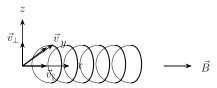
Drawn by us to help you understand the concept clearly, and verified to make sure it's accurate. For exams, practice from your textbook's own diagram.
What this figure shows. A three-dimensional sketch with the magnetic field drawn along the z axis (vertical), and a charged particle's trajectory drawn as a coil/spring-like helix wound around and progressing steadily along this z axis, in the x-y-z coordinate frame shown. The helix's axis coincides exactly with the direction of , illustrating that the particle simultaneously (i) circles around the field direction in the x-y plane (due to ) while (ii) advancing at a constant rate along the field direction itself (due to the unaffected ), so the combined path is neither a pure circle nor a straight line bu …