Physics · Ch 5 — Oscillations
Amplitude of S.H.M.
Amplitude of S.H.M.
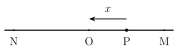
Consider a particle P performing linear S.H.M. along a straight-line path MN, with O marking the centre of MN -- the mean (equilibrium) position of the particle (Fig. 5.2). From the general displacement expression (Eq. 5.12), the particle's displacement reaches its greatest possible magnitude exactly when , i.e. when . This maximum possible displacement, A, is called the amplitude of the S.H.M.
Formally: the amplitude of a particle performing S.H.M. is the maximum displacement of the particle from its mean position. Geometrically, in Fig. 5.2, the amplitude A is simply the distance OM (or, equivalently, ON) -- the half-length of the full oscillation path MN. It is a positive quantity, fixed for a given oscillation (it does not change from one cycle to the next unless energy is added to or removed from the system, as happens under damping, section 5.14), and it sets the overall " …
Drawn by us to help you understand the concept clearly, and verified to make sure it's accurate. For exams, practice from your textbook's own diagram.
What this figure shows. A single straight line segment MN drawn horizontally, representing the full path of a particle P performing linear S.H.M. The centre point O of the segment MN is marked and labelled as the mean (equilibrium) position of the particle. The particle P is shown at some general point along MN, at a distance x from O, with M and N marking the two extreme ends of the path (the leftmost and rightmost points the particle can reach), each at a distance A (the amplitude) from O -- so the total length of the path MN equals 2A. The figure is a simple one-dimensional schematic establishing the geometric relationship between the mean position O, the amplitude A (the half-length OM = ON), and an arbitrary instantaneous position …