Physics · Ch 5 — Oscillations
Combination of Springs
Combination of Springs
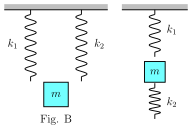
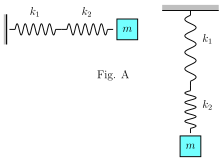
The formulas derived so far assumed a single spring of force constant k. In practice, springs are often combined -- either in SERIES (one after another, forming a single chain, Fig. A) or in PARALLEL (side by side, both connected between the same two points, Fig. B) -- and it is useful to be able to replace any such combination by a single EFFECTIVE spring constant, so that the period formula can still be applied directly without re-deriving everything from scratch.
Drawn by us to help you understand the concept clearly, and verified to make sure it's accurate. For exams, practice from your textbook's own diagram.
What this figure shows (Figure B — parallel). Springs connected between the same two points, so they all have the SAME extension e and share the total force. Their forces add: the effective spring constant is kₚ = k₁ + k₂ (for two springs), and kₚ = mk for m identical springs. A paral …
Drawn by us to help you understand the concept clearly, and verified to make sure it's accurate. For exams, practice from your textbook's own diagram.
What this figure shows (Figure A — series). Springs connected one after another in a single chain. Each spring in series carries the SAME stretching force f, so their extensions add: the effective spring constant kₛ satisfies 1/kₛ = 1/k₁ + 1/k₂ (for two springs). A series combination is softer ( …
Series combination (Fig. A): consider two massless springs of force constants and , joined end to end in a single chain, with a stretching force f applied at the free end (for a vertical arrangement, f would be the weight mg of a hanging mass). Because the springs form one unbroken chain, EACH spring individually experiences the SAME force f (there is nothing to make the force different in the two springs), but each stretches by its own extension: for the first spring and for the second. The TOTAL extension of the combination is the sum of the two individual extensions:
If is the effective spring constant of the series combination (i.e. the constant of a single spring that would give this SAME total extension e for the SAME force f), then , and comparing with the equation above,
This generalises directly to any number of springs joined in series: . A useful special case: for n IDENTICAL springs, each of constant k, joined in series, -- notice that a series combination is always WEAKER (has a smaller effective constant, hence a LONGER period) than any single spring in the chain.
Parallel combination (Fig. B): now consider two massless springs of constants , connected between the SAME two points -- both fixed at one end to a common support, and both attached at the other end to the same point, where the stretching force f is applied. Because both springs span the identical gap between the same two points, they are forced to stretch by the exact SAME extension e (there is no way for one to stretch more than the other while both stay attached at both ends). But each spring, at that shared extension e, contributes its own share of the total restoring force: from the first spring, from the second. Since the two springs together must support the entire applied force,
…