History · Ch 1 — Bricks, Beads and Bones — The Harappan Civilisation
A new old civilisation
A new old civilisation
The Discovery of a New Civilisation
The Harappan Civilisation was not always known as an ancient culture. For a long time, its ruins were mistaken for much later settlements. The turning point came when archaeologists began finding seals at Harappa and Mohenjodaro.
- Daya Ram Sahni (early 1900s) found seals at Harappa in layers much older than the Early Historic period.
- Rakhal Das Banerji found similar seals at Mohenjodaro.
- This suggested both sites belonged to a single archaeological culture.
In 1924, John Marshall, Director-General of the Archaeological Survey of India (ASI), announced the discovery of a new civilisation in the Indus valley. The world now knew of a civilisation that was contemporaneous with Mesopotamia — a fact confirmed when similar seals were found at Mesopotamian sites.
S.N. Roy noted: “Marshall left India three thousand years older than he had found her.”
Marshall’s Approach to Archaeology
John Marshall was the first professional archaeologist in India, having worked in Greece and Crete. He brought two key changes:
- Interest in everyday life — Unlike earlier archaeologists (like Cunningham) who focused only on spectacular finds, Marshall wanted to understand patterns of daily life.
- Horizontal excavation — He excavated along regular horizontal units, measured uniformly across the mound, ignoring stratigraphy (the natural layering of soil).
The Problem with Ignoring Stratigraphy …
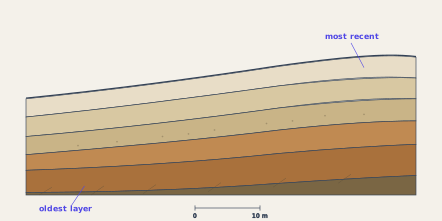
Drawn by us to help you understand the concept clearly, and verified to make sure it's accurate. For exams, practice from your NCERT textbook's own diagram.
What Figure 1.25 Shows
The figure is a cross-sectional drawing of a small archaeological mound, not a photograph or map. It reveals the internal structure of the mound as seen from the side — as if a vertical slice had been cut through it. The mound is depicted as a roughly dome-shaped or gently sloping heap of earth, with its layers (strata) clearly marked.
- Layers are not horizontal: The most important visual detail is that the occupation layers are wavy, sloping, or uneven — they do not run in straight, parallel lines across the mound. This reflects the real-world process of mound formation: debris, rubbish, and building materials were dumped or accumulated unevenly over time, and later disturbances (digging, erosion, rebuilding) tilted or warped the layers.
- Oldest at the bottom, youngest at the top: The lowest layer in the cross-section represents the earliest occupation of the site, while the uppermost layer is the most recent. This is the core principle of stratigraphy — the study of layered deposits to determine relative chronology.
- No labels for specific sites or artefacts: The figure does not name any particular Harappan site (like Harappa or Mohenjodaro) or show any objects (seals, pottery, etc.). It is a generic diagram meant to illustrate the concept of stratigraphy itself, not a record of a specific excavation.
- Purpose in the textbook: The figure appears in the section discussing John Marshall’s excavation methods. Marshall ignored stratigraphy by digging in regular horizontal units (like slicing a cake into equal horizontal slabs), which mixed artefacts from different time periods together. The figure shows why this was a mistake: because the layers are not horizontal, a single horizontal unit would cut across multiple layers, jumbling objects from different centuries. The diagram thus teaches that proper excavation must follow the natural slope of the layers, not arbitrary horizontal lines.
What It Teaches About Stratigraphy
- Stratigraphy is the key to relative dating: By observing which layer lies above or below another, archaeologists can determine which artefacts are older or younger — even without absolute dates.
- Layers are rarely neat: Real mounds are messy. People dig pits, build walls, dump trash, and abandon areas, causing layers to tilt, pinch out, or mix. The figure’s non-horizontal layers remind us that excavation must be careful and layer-by-layer, not mechanical. …