History · Ch 1 — Bricks, Beads and Bones — The Harappan Civilisation
Laying out drains
Laying out drains
The Drainage System: A Concept-First View
The Harappan drainage system was not an afterthought—it was the foundation of city planning. The entire layout of streets and houses was designed around the need to carry away waste water efficiently.
Why Drains Came First
The textbook explains that streets with drains were laid out before houses were built. This is a key insight: the city's "skeleton" was the drainage network. For a house to connect to the street drain, it needed at least one wall along a street. This created a grid pattern—roads and streets intersecting at right angles—because drains run straight and turn at corners.
The Grid Pattern and Drain Flow
The grid pattern is not just aesthetic; it is functional. If streets are straight and meet at right angles, drains can flow in straight lines and join at predictable points. This minimizes blockages and makes cleaning easier.
Citadels and Variations
Not all Harappan cities were identical. While most had a small, high western part (the citadel) and a larger, lower eastern part (the lower town), some sites like Dholavira and Lothal had the entire settlement fortified. At Lothal, the citadel was not walled off but was built at a height—this elevation helped with drainage, as water flows downhill.
Key Quantitative Idea: Drain Slope
The textbook does not give a formula for drain slope, but the physical principle is implicit: for waste water to flow, drains must have a gradient (slope). The slope is the ratio of vertical drop to horizontal distance: …
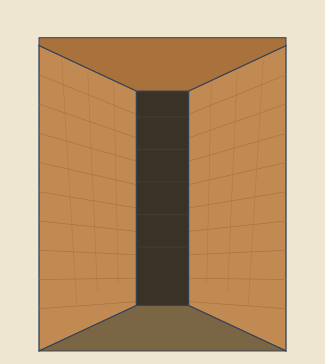
Drawn by us to help you understand the concept clearly, and verified to make sure it's accurate. For exams, practice from your NCERT textbook's own diagram.
What the Figure Shows
Figure 1.8 is a photograph of a large, brick-built covered drain located in the ancient city of Mohenjodaro. The drain runs along what was a street, and its most striking feature is a prominent, wide opening — a manhole or inspection hole — that allowed access for cleaning and maintenance. The drain itself is constructed from standardised baked bricks, laid in a careful, sloping manner to ensure waste water flowed away efficiently. The cover over the drain is made of brick or stone slabs, with the opening left uncovered to reveal the channel inside.
What It Teaches About Harappan Urban Planning
This single image is a powerful visual summary of the Harappan civilisation's most distinctive achievement: its carefully planned drainage system. The textbook explains that streets and drains were laid out first, in an approximate grid pattern intersecting at right angles, and houses were built along them. The figure confirms this — the drain is not an afterthought but an integral part of the street layout.
The huge opening shown in the photograph is not just a structural detail; it reflects a sophisticated understanding of public sanitation and civic maintenance. Such openings allowed workers to periodically clear blockages, ensuring the system remained functional. This level of planning — where every house could drain waste water into a street drain — required that every house had at least one wall along a street, a rule that shaped the entire city's design.
Broader Context: Citadels and Variations …
This primary-source note records Ernest Mackay's assessment of Mohenjodaro's drainage:
"It is certainly the most complete ancient system as yet discovered." Every house was connected to the street drains. The main channels were made of bricks set in mortar and were covered with loose bricks that could be removed for cleaning. In some cases, limestone was used for the covers. House drains first emptied into a sump or cesspit into which solid matter settled while waste water flowed out into the street drains. Very long drainage channels were provided at intervals with sumps for cleaning. It is a wonder of archaeology that "little heaps of material, mostly sand, have frequently been found lying alongside drainage channels, which shows … that the debris was not always carted away when the drain was cleared".
— Ernest Mackay, Early Indus Civilisation, 1948 …