History · Ch 1 — Bricks, Beads and Bones — The Harappan Civilisation
Burials
Burials
Understanding Social Differences Through Burials
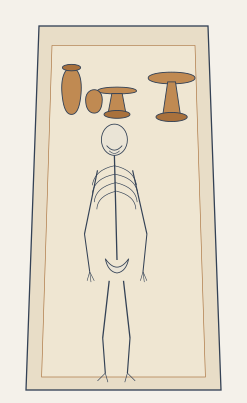
Archaeologists study burials to infer social or economic differences within a culture. The Harappan civilisation, contemporary with Egyptian pyramids, had its own burial practices. Unlike the massive, wealth-filled royal pyramids of Egypt, Harappan burials were simpler. The dead were generally laid in pits. Variations in these pits—such as brick lining—might hint at social differences, but this is not certain.
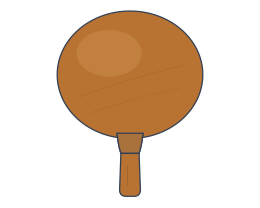
Grave goods like pottery and ornaments were sometimes included, possibly for use in an afterlife. Jewellery appears in burials of both men and women. For example, in a Harappan cemetery excavation (mid-1980s), a male skull was found with an ornament of three shell rings, a jasper bead, and hundreds of micro beads. Some burials also contained copper mirrors. However, overall, the Harappans did not bury large amounts of precious items with the dead.
Key Ideas from the Text
- Burial pits: The dead were placed in pits, sometimes lined with bricks.
- Grave goods: Pottery, ornaments, and copper mirrors were found, but not in large quantities. …
Drawn by us to help you understand the concept clearly, and verified to make sure it's accurate. For exams, practice from your NCERT textbook's own diagram.
What the Figure Shows
The figure is a simple line drawing of a single object: a copper mirror from the Harappan civilisation. It is not a photograph but a schematic illustration, likely showing the mirror from a front or slightly angled view. The mirror is depicted as a flat, circular or slightly oval disc, with a short handle or tang attached to one edge. The surface is plain, without any visible decoration or inscription. The handle is narrow and straight, suggesting it was meant to be held or possibly inserted into a stand.
What It Teaches About Harappan Burials
This figure appears in the section on burials to illustrate a specific practice: the occasional placement of copper mirrors with the dead. The textbook text notes that while most Harappan burials were simple pits with few grave goods, some contained items like pottery, ornaments, and copper mirrors. The mirror shown is a tangible example of such an object. …
Drawn by us to help you understand the concept clearly, and verified to make sure it's accurate. For exams, practice from your NCERT textbook's own diagram.
The figure shows a schematic drawing of a single Harappan burial pit as it might have appeared during excavation. It is a top-down view, looking straight into the grave from above.
What is depicted:
- A rectangular pit dug into the ground, outlined by the edges of the cut.
- Inside the pit, the outline of a human skeleton is shown lying on its back (supine), with the head at one end and the feet at the other. The arms are placed straight alongside the body.
- Around the skeleton, several small objects are drawn:
- A few pots or vessels (likely pottery) placed near the head and feet.
- Small circles or dots representing beads or ornaments, clustered near the neck/chest area (suggesting a necklace or a string of beads) and possibly near the wrists or ankles.
- The drawing uses simple, clear lines — no shading or colour — typical of a textbook diagram meant to show the layout of a grave.
What it teaches about the topic:
- Burial practice: The dead were laid in simple pits, not in elaborate chambers. This matches the textbook’s statement that “the dead were generally laid in pits.”
- Grave goods: The presence of pottery and ornaments near the body illustrates the Harappan practice of placing items with the dead, possibly for use in an afterlife. The textbook notes that “some graves contain pottery and ornaments, perhaps indicating a belief that these could be used in the afterlife.”
- Social differences (or lack thereof): The figure shows a modest burial — no massive wealth, no brick lining. This aligns with the textbook’s conclusion that “on the whole, it appears that the Harappans did not believe in burying precious things with the dead.” The figure helps students see that Harappan burials were generally simple and uniform, unlike the contemporary Egyptian pyramids. The variation mentioned in the text (brick-lined pits) is not shown in this figure — it depicts the more common, unlined pit. …