History · Ch 1 — Bricks, Beads and Bones — The Harappan Civilisation
Subsistence Strategies
Subsistence Strategies
Concept First
Subsistence strategies refer to the methods by which a society obtains food and other necessities for survival. For the Harappan Civilisation, this involved a combination of agriculture, animal husbandry, fishing, and hunting. Archaeologists reconstruct these practices by studying plant remains (grains, seeds) and animal bones found at sites, using specialists like archaeo-botanists and archaeo-zoologists.
Key Ideas from the Text
- Dietary Range: Harappans ate a wide variety of plant and animal products, including fish. Evidence comes from charred grains and seeds (studied by archaeo-botanists) and animal bones (studied by archaeo-zoologists).
- Crops Grown:
- Wheat, barley, lentil, chickpea, and sesame are common at Harappan sites.
- Millets are found specifically at sites in Gujarat.
- Rice is relatively rare.
- Domesticated Animals: Cattle, sheep, goat, buffalo, and pig were domesticated (based on bone studies).
- Wild Animals: Bones of wild boar, deer, gharial, fish, and fowl are also found, but it is unclear if Harappans hunted them or obtained meat from other communities.
Agricultural Technologies
- Ploughing:
- Representations on seals and terracotta sculptures show the bull was known, suggesting oxen were used for ploughing.
- Terracotta models of ploughs have been found at Cholistan and Banawali (Haryana).
- A ploughed field at Kalibangan (Rajasthan) from Early Harappan levels shows two sets of furrows at right angles to each other. This indicates that two different crops were grown together (intercropping).
- Harvesting Tools: Archaeologists debate whether stone blades set in wooden handles or metal tools were used. Copper tools (Fig. 1.4) are found, but their exact use is uncertain.
- Irrigation:
- Most Harappan sites are in semi-arid lands, so irrigation was likely needed.
- Traces of canals have been found at Shortughai (Afghanistan), but not in Punjab or Sind. Canals may have silted up long ago.
- Water from wells may have been used for irrigation.
- Water reservoirs at Dholavira (Gujarat) may have stored water for agriculture.
- Food Processing: …
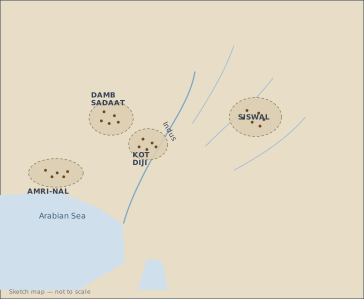
What Map 2 Shows
Map 2 is a sketch map (not to scale) that illustrates the geographical spread of Early Harappan cultures — the Amri-Nal, Kot Diji, Damb Sadaat, and Siswal cultures. These are the pre-urban, formative phases that preceded the Mature Harappan (Indus Valley) Civilisation.
The map covers the region along the Indus River and the Arabian Sea coast, extending into parts of present-day Pakistan and western India. The area shown largely overlaps with the later Mature Harappan zone, as the textbook text notes: “the Mature Harappan culture developed in some of the areas occupied by the Early Harappan cultures.”
Key Labels and Features
- Amri-Nal: A cultural phase named after sites in Sindh (Pakistan) and Balochistan, known for distinctive pottery and early agriculture.
- Kot Diji: An Early Harappan site in Sindh, characterised by fortified settlements and pre-Harappan pottery.
- Damb Sadaat: A site in Balochistan, representing a regional variant of the Early Harappan period.
- Siswal: A site in Haryana (India), associated with the Early Harappan culture in the Ghaggar-Hakra (Saraswati) basin.
- Indus River: The major river system around which these early cultures clustered.
- Arabian Sea: The coastline along which some Early Harappan sites are located, indicating maritime connections.
The map does not show individual settlements, artefacts, or arrows — only the broad cultural zones and their names, placed over the Indus and coastal region.
What the Map Teaches
-
Continuity of Occupation: The Early Harappan cultures occupied the same broad region where the Mature Harappan civilisation later flourished. This suggests that the Harappan civilisation did not appear suddenly but evolved from earlier, smaller-scale farming and pastoral communities.
-
Regional Diversity: The four named cultures (Amri-Nal, Kot Diji, Damb Sadaat, Siswal) represent distinct regional traditions, each with its own pottery styles, settlement patterns, and subsistence strategies. Yet they shared common elements — such as agriculture, animal domestication, and trade — that laid the groundwork for the later urban phase. …