History · Ch 1 — Bricks, Beads and Bones — The Harappan Civilisation
Identifying centres of production
Identifying centres of production
Identifying Centres of Production
Archaeologists determine where craft production happened by looking for specific physical evidence left behind during the manufacturing process. The logic is simple: wherever raw materials were worked into finished objects, traces of that work remain.
Key Indicators of a Production Centre
The presence of any of the following suggests a site was a centre of craft production:
- Raw materials – unworked stone nodules, whole shells, copper ore, etc.
- Tools – implements used to shape or cut materials.
- Unfinished objects – items that were partially worked but never completed.
- Rejects and waste material – broken or discarded pieces from the production process.
Why Waste is the Best Indicator
Waste is especially reliable because it is not reused and stays at the work site. For example:
- If shell or stone is cut to make beads or objects, the leftover chips, flakes, and broken pieces are discarded at that location.
- Larger waste pieces might be reused to make smaller objects, but minuscule bits (tiny fragments) are almost always left behind in the work area.
Thus, the presence of waste material is a strong sign that production occurred there. …
Drawn by us to help you understand the concept clearly, and verified to make sure it's accurate. For exams, practice from your NCERT textbook's own diagram.
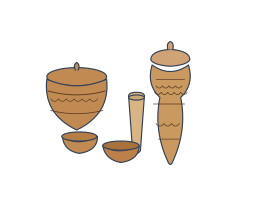
Figure 1.14 is a photograph of Harappan pottery — a collection of finished vessels arranged to show their uniform shapes and sizes. The image typically displays several pots, jars, and bowls in a row or grid, all made from a fine, well-levigated clay and fired to a red or buff colour. The surfaces are smooth and often burnished, with black painted designs — geometric patterns (horizontal bands, loops, intersecting circles) or natural motifs (fish scales, peacocks, trees).
The key point the figure illustrates is standardisation: the vessels look almost identical in form and finish, whether they come from Harappa, Mohenjodaro, Lothal, or other sites. This uniformity is not accidental — it suggests centralised control over production techniques and possibly mass production in specialised workshops.
The caption “Pottery” is deliberately simple because the image itself is the evidence. The textbook uses it to support the idea that craft production was organised and widespread, not just a household activity. The pottery shown is utilitarian (for storage, cooking, water carrying) but its fine finish and painted decoration also hint at aesthetic or ritual value — blurring the line between utility and luxury. …
Drawn by us to help you understand the concept clearly, and verified to make sure it's accurate. For exams, practice from your NCERT textbook's own diagram.
What the Figure Shows
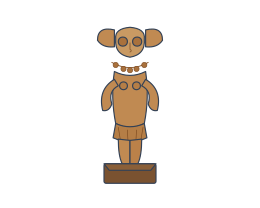
Figure 1.15 is a photograph of a terracotta figurine — a small, fired-clay sculpture — of the type commonly excavated at Harappan sites. The figurine is not labelled with a specific site name in the caption, but the textbook context places it among artefacts from major cities like Mohenjodaro and Harappa.
The figurine is a human or animal form (the caption does not specify which, but typical Harappan terracottas include both). It is handmade or moulded, with simple, stylised features — often with pinched eyes, a prominent nose, and a flat base. The surface is unpainted (terracotta’s natural reddish-brown colour), and it may show minor cracks or wear from burial.
No arrows, panels, or labels appear on the figure itself. The image is a standalone photograph, not a diagram. The caption simply reads: “A terracotta figurine” — no further details about size, exact findspot, or current location are given in the description.
What It Teaches About Craft Production
This figurine is a finished object — the end product of a craft process. Its presence at Harappan sites helps archaeologists understand where and how crafts were made.
- Raw material: Terracotta figurines were made from local clay, readily available in the Indus floodplain.
- Tools & waste: The textbook explains that waste material (e.g., broken clay bits, mis-shapen pieces) is a key indicator of craft centres. If this figurine were found alongside unfinished clay lumps, broken moulds, or kiln debris, it would suggest a workshop nearby.
- Scale of production: The figurine is small and portable, typical of items produced in large quantities in cities. The textbook notes that craft production occurred both in small specialised centres and in big cities like Mohenjodaro and Harappa.
Thus, the figurine is not just an art object — it is evidence of organised craft activity, showing that Harappan artisans had mastered firing clay and could produce standardised, durable goods for daily use, ritual, or trade.