History · Ch 1 — Bricks, Beads and Bones — The Harappan Civilisation
Problems of interpretation
Problems of interpretation
Interpreting Harappan Religion: The Problem of Moving from the Known to the Unknown
Archaeologists face a major challenge when trying to understand Harappan religious practices. Since there are no written records from the Harappan period, interpretations are often based on analogy — comparing objects and structures from the past with those from later, better-known periods. This method is useful for everyday tools (like stone querns or pots), but becomes highly speculative when applied to religious symbols.
Key Objects and Their Interpretations
- Terracotta figurines of women (heavily jewelled, with elaborate head-dresses) were initially labelled as "mother goddesses".
- Stone statuary of men in a standardised seated posture (one hand on the knee) — like the "priest-king" — were also classified as religious figures.
- Structures like the Great Bath and fire altars (at Kalibangan and Lothal) were assigned ritual significance.
- Seals depicting ritual scenes, plant motifs, or mythical animals (like the "unicorn") were thought to indicate nature worship or composite deities.
- Conical stone objects (made of lapis lazuli, jasper, chalcedony) were classified as lingas — but the excavator Mackay noted they could equally be gamesmen used in board games.
The "Proto-Shiva" Seal: A Case Study in Speculation
One of the most debated objects is a seal showing a figure seated cross-legged in a "yogic" posture, surrounded by animals. This was interpreted as "proto-Shiva" — an early form of the Hindu god Shiva.
The argument from analogy:
- Later Hindu tradition (Puranic, first millennium CE) associates Shiva with the name Rudra.
- The Rigveda (compiled c. 1500–1000 BCE) mentions Rudra.
- However, Rudra in the Rigveda is NOT described as Pashupati (lord of animals) nor as a yogi.
- Therefore, the seal's depiction does not match the Rigvedic description of Rudra.
Alternative interpretation: Some scholars suggest the figure might be a shaman — a person claiming magical and healing powers, and the ability to communicate with the spirit world.
The Fundamental Problem: Moving from the Known to the Unknown
Archaeologists often reason from the present to the past (the known to the unknown). While this works for material objects (stone querns, pots), it becomes speculative for religious symbols. The same object can have multiple plausible interpretations — a conical stone could be a linga or a gamesman. …
What Figure 1.26 Shows
The figure is a photograph of a terracotta female figurine — a small, baked clay sculpture — from the Harappan Civilisation. The figurine is depicted as heavily jewelled, with an elaborate head-dress that covers much of the head. The jewellery includes multiple necklaces, possibly armlets and anklets, and the head-dress is ornate, often with fan-like or horn-like projections. The figurine is shown standing, with arms at the sides or slightly raised. The terracotta is typically reddish-brown, the natural colour of fired clay.
What It Teaches About Harappan Religion and Interpretation
- Early archaeologists labelled such figurines as "mother goddesses" — a term implying a fertility or earth-mother deity. This interpretation was based on the assumption that the heavy jewellery and elaborate head-dress signified a divine or ritual figure.
- The textbook caption asks: "Was this a mother goddess?" — directly challenging this early assumption. The question mark is crucial: it signals that the identification is speculative, not proven.
- The figurine is part of a broader pattern: many Harappan objects (terracotta women, stone "priest-king" statues, the Great Bath, fire altars, seals with "proto-Shiva" figures, conical stones as lingas) were assigned religious meaning by early excavators. But these interpretations often project later Hindu traditions onto Harappan artefacts — a method called "moving from the known to the unknown" (present to past).
- The textbook warns that such reconstructions become "more speculative" when applied to religious symbols. For example, the "proto-Shiva" seal does not match the Rigvedic description of Rudra (the early form of Shiva), so it may instead represent a shaman — a person claiming magical/healing powers and communication with the spirit world.
- The figurine thus illustrates a key problem in archaeology: how do we know what was religious? Without texts or clear context, we risk imposing our own cultural categories. The figurine could have been a toy, a votive offering, a symbol of fertility, or something else entirely.
Key Takeaway …
What the "Proto-Shiva" Seal Depicts
The seal shows a central human figure seated in a cross-legged posture, with the heels pressed together and the hands resting on the knees — a pose that resembles a yogic asana. The figure is ithyphallic (an erect phallus is shown), and is surrounded by four animals: an elephant, a tiger, a rhinoceros, and a buffalo. Below the figure’s stool-like seat are two deer (or antelopes), facing away from each other. The entire composition is carved on a steatite seal, typical of Harappan craftsmanship.
What It Teaches About Harappan Religion and Interpretation
- The "proto-Shiva" label comes from the figure’s yogic posture and its association with animals, which some scholars (like Sir John Marshall) linked to the later Hindu god Shiva as Pashupati ("lord of animals"). However, the textbook warns that this interpretation is speculative.
- The Rigveda (c. 1500–1000 BCE) mentions a god Rudra, but Rudra is not described as a yogi or as Pashupati. So the seal’s imagery does not match the earliest Vedic evidence — it only resembles later Puranic traditions (first millennium CE).
- Some scholars have suggested the figure might be a shaman (a person with magical/healing powers) rather than a deity, because the "yogic" posture could indicate a trance state. …
What Figure 1.28 Shows
The figure is a photograph of small, finely cut conical stones made from semi-precious materials: lapis lazuli (deep blue), jasper (red or brown), and chalcedony (translucent white/grey). Each cone is less than two inches in height, beautifully polished and finished. They are arranged in a simple row or cluster, with no background context or labels — the image focuses entirely on the objects themselves.
The Interpretive Puzzle
The caption — "Gamesmen or lingas?" — directly poses the central problem. These objects are physically identical to what later Hindu tradition calls a linga (a polished stone symbol of Shiva). However, they are also identical in size, shape, and craftsmanship to board-game pieces (gamesmen) used in ancient games like pachisi or chaupar. The textbook includes a quote from archaeologist Ernest Mackay (one of the earliest excavators), who explicitly states: "Various small cones… are also thought to be lingas… on the other hand, it is just as possible that they were used in the board-games."
What It Teaches About Interpretation
This figure is a case study in archaeological ambiguity. It shows that:
- Same object, multiple meanings: Without written records or clear context, the same artefact can be interpreted as religious (linga) or secular (game piece). Neither interpretation is proven.
- The "known to unknown" trap: Archaeologists often assume later traditions (e.g., Hindu linga worship) explain earlier objects. But this is speculative — the Harappans may have had no such concept.
- Material evidence is not enough: The stones are exquisitely made, but their use is invisible. The figure forces students to ask: How do we decide what an object meant to its makers? …
Drawn by us to help you understand the concept clearly, and verified to make sure it's accurate. For exams, practice from your NCERT textbook's own diagram.
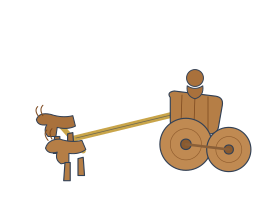
What Figure 1.29 Shows
Figure 1.29 is a photograph of a terracotta toy model of a bullock cart. It is a small, solid object made from baked clay, typical of the many such models found at Harappan sites. The cart is shown with two wheels, a platform for carrying goods or people, and a yoke for attaching a pair of bullocks. The model is simple and functional, not ornate — it was likely a child’s toy or a miniature representation of a real cart.
What It Teaches About the Harappan Civilisation
This figure is placed in the textbook’s discussion of problems of interpretation — specifically, how archaeologists decide whether an object was used for daily life, ritual, or play. The cart is a clear example of a non-religious artefact: it shows that wheeled transport was used for moving goods and people across land routes. Unlike the “mother goddess” figurines or “proto-Shiva” seals discussed in the same section, this object does not require speculative religious interpretation. Its function is obvious from its shape.
The cart also provides evidence of Harappan technology and economy:
- Wheeled transport implies knowledge of the wheel, axle, and animal domestication (bullocks).
- Trade and movement — carts would have been essential for carrying agricultural produce, craft goods, and building materials between settlements.
- Craft production — the terracotta model itself shows that potters could make detailed, durable toys, indicating a level of skill and standardisation.