History · Ch 1 — Bricks, Beads and Bones — The Harappan Civilisation
Palaces and kings
Palaces and kings
Understanding Power and Authority in Harappan Society
Archaeologists have found no clear evidence of a single ruler or a central palace in the Harappan civilisation. This makes it difficult to determine how power was organised.
- A large building at Mohenjodaro was labelled a "palace", but it contained no spectacular finds (like treasures or royal inscriptions) to confirm it was a ruler's residence.
- A stone statue found at the same site is called the "priest-king" — a name borrowed from Mesopotamian parallels. However, we do not know if this person actually held political power or was simply a ritual specialist.
Different Views on Harappan Rulership
Scholars have proposed several competing theories:
- No rulers at all — Some argue that Harappan society was egalitarian, with everyone enjoying equal status.
- Multiple rulers — Others suggest that each major city (Mohenjodaro, Harappa, etc.) had its own separate ruler.
- A single state — This view is supported by:
- Similarity in artefacts across sites
- Planned settlements with standardised layouts
- Standardised ratio of brick size — a key quantitative clue
- Settlements established near raw material sources
The Brick Size Ratio: A Quantitative Clue
The standardised ratio of brick size is one of the strongest pieces of evidence for a central authority. If bricks across all Harappan sites follow the same dimensional ratio, it suggests a common planning agency.
Let the dimensions of a typical Harappan brick be:
- Length =
- Breadth =
- Height =
The standardised ratio is:
This means:
- , , for some constant (e.g., cm gives cm, cm, cm). …
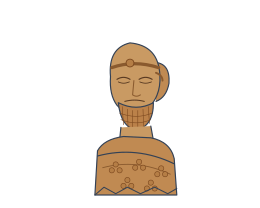
Drawn by us to help you understand the concept clearly, and verified to make sure it's accurate. For exams, practice from your NCERT textbook's own diagram.
What the Figure Shows
The figure is a photograph of a stone statue excavated at Mohenjodaro, one of the major cities of the Harappan Civilisation. The statue is carved from steatite (a soft stone) and depicts a seated bearded man in a formal, upright posture. His right hand rests on his knee, and his left hand is placed on his chest or lap. He wears a fillet (a headband) around his forehead, with a decorative armband on his upper arm. The beard is carefully trimmed, and the hair is combed back. The eyes are half-closed, giving a meditative or authoritative expression.
What It Teaches About Harappan Society
- No direct evidence of kings: The statue is labelled “priest-king” by archaeologists because it resembles similar figures from Mesopotamia (modern Iraq), where such titles were used for rulers who also held religious authority. However, the textbook emphasises that we do not know whether this figure actually represents a priest, a king, or both. No inscriptions or symbols confirm his identity.
- Debate on political structure: The figure is central to the debate about whether Harappan society had rulers. Some archaeologists argue that the statue shows a powerful individual, suggesting a centralised state with a single ruler. Others point out that no palaces or royal tombs have been found, and that the statue might represent a priest or a mythical figure, not a king. The textbook notes that some scholars believe Harappan society was egalitarian (everyone equal) or had multiple rulers for different cities.
- Limits of archaeological interpretation: The figure reminds us that labels like “priest-king” are modern guesses, not facts. The Harappan script remains undeciphered, so we cannot read what the statue meant to its makers. The textbook warns that “ritual practices are not well understood yet” and that we cannot know if religious leaders also held political power.