History · Ch 1 — Bricks, Beads and Bones — The Harappan Civilisation
Contact with distant lands
Contact with distant lands
Contact with Distant Lands
The Harappans were not isolated. Archaeological and textual evidence shows they had extensive trade and cultural links with regions as far away as Mesopotamia (modern Iraq), Oman, and Bahrain. This contact was driven by the need for raw materials, especially copper.
Copper from Oman
- Source of Copper: Recent finds suggest copper was brought from Oman (on the southeastern tip of the Arabian peninsula).
- Chemical Evidence: Chemical analysis reveals that both Omani copper and Harappan artefacts contain traces of nickel. This common impurity strongly suggests a shared origin for the metal.
- Physical Evidence: A distinctive type of large Harappan jar, coated with a thick layer of black clay, has been found at Omani sites. This coating prevents liquid from seeping through, indicating it was used to transport some commodity—possibly exchanged for Omani copper.
Mesopotamian Texts and Trade
- Textual References: Mesopotamian texts from the third millennium BCE mention copper coming from a region called Magan (likely Oman). Copper found at Mesopotamian sites also contains nickel traces, confirming this link.
- Named Regions: The texts refer to three key regions:
- Dilmun: Probably the island of Bahrain.
- Magan: Likely Oman.
- Meluhha: Possibly the Harappan region.
- Goods from Meluhha: The texts list products imported from Meluhha: carnelian, lapis lazuli, copper, gold, and various types of wood.
- The Haja-bird: A Mesopotamian myth mentions the "haja-bird" from Meluhha. Some archaeologists believe this was the peacock, possibly named after its call.
Evidence of Contact
- Harappan Artefacts Abroad: Harappan seals, weights, dice, and beads have been found in Mesopotamia.
- Mesopotamian Seals with Harappan Motifs: A cylinder seal (typical of Mesopotamia) found in the region features a humped bull motif, which appears to be derived from the Indus region. …
What Figure 1.17 Shows
The figure is a photograph of a large Harappan storage jar — a distinctive vessel with a thick coating of black clay. This coating is not decorative; it serves a practical purpose: it prevents liquids from seeping through the porous clay of the jar. The jar is of the type that has been excavated at Omani sites (on the southeastern tip of the Arabian Peninsula, known in ancient Mesopotamian texts as Magan).
What It Teaches About Harappan Contacts
The presence of this jar in Oman is direct archaeological evidence of contact and exchange between the Harappan region and distant lands. The textbook explains that:
- Copper was probably brought from Oman to the Harappan region. Chemical analyses show that both Omani copper and Harappan artefacts contain traces of nickel, suggesting a common origin.
- The jar itself may have been used to transport goods — perhaps liquids or other commodities — that the Harappans exchanged for Omani copper.
- Other finds at Omani sites include Harappan seals, weights, dice, and beads, reinforcing the idea of regular trade.
The Broader Context: Routes and Regions
The figure is part of a discussion about long-distance contacts between the Harappan civilisation and regions like:
- Dilmun (probably the island of Bahrain)
- Magan (Oman)
- Meluhha (likely the Harappan region itself) …
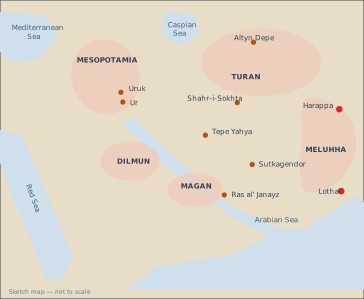
What the Map Shows
Map 3 is a sketch map (not to scale) that illustrates the long-distance contacts between the Harappan Civilisation and regions of West Asia during the third millennium BCE. It is not a detailed political map but a conceptual diagram linking key sites and regions across seas and land routes.
Regions and Sites Labelled
-
MELUHHA – This is the name used in Mesopotamian texts for the Harappan region. The map places it in the Indus Valley area, with three Harappan sites marked:
- Harappa (in Punjab, Pakistan)
- Lothal (in Gujarat, India – a major port)
- Sutkagendor (in Balochistan, Pakistan – near the Makran coast)
-
MESOPOTAMIA – The region of modern Iraq, with two cities shown:
- Uruk (one of the earliest cities)
- Ur (a major Sumerian city-state)
-
MAGAN – Likely the region of Oman (southeastern Arabian peninsula), a source of copper.
-
DILMUN – Probably the island of Bahrain in the Persian Gulf, an important trading hub.
-
TURAN – A region in Central Asia (modern Turkmenistan, Uzbekistan, parts of Iran and Afghanistan).
-
Sites in Iran and Central Asia:
- Shahr-i-Sokhta (in Iran, near the Afghanistan border)
- Tepe Yahya (in southeastern Iran)
- Altyn Depe (in Turkmenistan)
-
Ras al' Janayz – A site on the coast of Oman (southeastern Arabian peninsula).
Seas and Water Bodies
The map shows the Arabian Sea, Red Sea, Mediterranean Sea, and Caspian Sea as the major water bodies that frame the region. These seas were the routes for maritime trade.
What the Map Teaches
The map is a visual summary of the evidence for long-distance trade and cultural contact between the Harappan civilisation and West Asia. It shows:
-
Sea routes connecting the Harappan coast (Lothal, Sutkagendor) to Magan (Oman), Dilmun (Bahrain), and Mesopotamia (Uruk, Ur). This matches the textbook's mention of Mesopotamian texts referring to Meluhha as a "land of seafarers" and the discovery of Harappan jars in Oman.
-
Land routes linking the Harappan region to Turan and sites like Shahr-i-Sokhta, Tepe Yahya, and Altyn Depe – indicating overland trade networks through Iran and Central Asia.
-
Key commodities that moved along these routes: copper from Magan (Oman), carnelian, lapis lazuli, gold, and wood from Meluhha, as mentioned in Mesopotamian texts.
-
Cultural exchanges – the map's placement of sites like Dilmun (Bahrain) is significant because local "Dilmun" weights followed the Harappan standard, and "Persian Gulf" seals found there carry Harappan motifs.
Layout and Relationships …
What Figure 1.18 Shows
This figure is a cylinder seal — a small, cylindrical object carved in reverse so that when rolled on clay, it leaves a raised impression. The seal shown is Mesopotamian in style, meaning its shape, carving technique, and typical use (as a personal signature or administrative tool) are characteristic of ancient Mesopotamia (modern Iraq).
The key motif on the seal is a humped bull — a bull with a prominent hump on its shoulders. This is significant because the humped bull (zebu) is a native animal of the Indian subcontinent, not of Mesopotamia. Its appearance on a Mesopotamian-style seal suggests that the motif was borrowed from the Indus region.
What It Teaches About the Topic
The figure illustrates long-distance contact between the Harappan Civilisation and Mesopotamia. The seal is not a Harappan object — it is Mesopotamian — but it carries a Harappan-inspired design. This indicates that ideas, artistic motifs, and possibly even artisans or traders moved between these regions.
The textbook places this seal alongside other evidence of contact: Harappan seals, weights, dice, and beads found in West Asia; Mesopotamian texts mentioning Meluhha (likely the Harappan region); and trade in goods like carnelian, lapis lazuli, copper, and wood. The humped bull motif on a Mesopotamian seal is a visual marker of cultural exchange — it shows that the Harappan influence reached beyond material goods to iconography.
Key Takeaway …
What the Figure Shows
Figure 1.19 depicts a round seal — not the typical square Harappan stamp seal, but a distinctive circular type known as a "Persian Gulf" seal (also called a Dilmun seal). The seal shown was found in Bahrain (the ancient land of Dilmun). Its round shape is characteristic of seals made in the Persian Gulf region, especially on the island of Bahrain.
The figure illustrates that this seal sometimes carries Harappan motifs — designs or symbols that are recognisably from the Indus Valley. For example, the humped bull or other Indus-style animals might appear on such seals, showing cultural borrowing.
The caption also notes a key archaeological detail: local Dilmun weights followed the Harappan standard. This means that the people of Dilmun (Bahrain) used the same weight system as the Harappans — a strong indicator of trade and shared commercial practices.
What It Teaches
This figure is placed in the section "Contact with distant lands" (Section 6.2). It supports the idea that the Harappan civilisation was not isolated — it had long-distance maritime contacts with West Asia.
- Dilmun (Bahrain) acted as a trade hub between Mesopotamia, Magan (Oman), and Meluhha (the Harappan region).
- The presence of Harappan motifs on a local Dilmun seal shows that cultural influence flowed both ways — Harappan designs were adopted in Bahrain.
- The matching weight standards suggest that trade was regular and organised, not just occasional. Standardised weights made commercial exchanges reliable. …
What Figure 1.20 Shows
The figure is a Harappan seal that depicts a boat. It is one of several archaeological finds — including seals, weights, dice, and beads — that point to long-distance contact by sea between the Harappan region and West Asia.
What It Teaches
- Seafaring evidence: The boat on the seal is a direct visual clue that Harappans built and used watercraft for travel and trade. The textbook notes that Mesopotamian texts describe Meluhha (likely the Harappan region) as “a land of seafarers.”
- Trade routes: The seal supports the idea that communication with Oman, Bahrain (Dilmun), and Mesopotamia was by sea. The chapter discusses how copper from Oman, large Harappan jars found at Omani sites, and Mesopotamian references to Meluhha’s products (carnelian, lapis lazuli, copper, gold, wood) all fit a maritime network.
- Cultural exchange: Alongside this seal, other figures in the chapter show a Mesopotamian cylinder seal with a Harappan-style humped bull (Fig. 1.18) and a “Persian Gulf” seal from Bahrain with Harappan motifs (Fig. 1.19). Together, they illustrate how goods, ideas, and artistic styles moved across the Arabian Sea.