History · Ch 1 — Bricks, Beads and Bones — The Harappan Civilisation
Agricultural technologies
Agricultural technologies
Agricultural Technologies in the Harappan Civilisation
The Harappans were an agricultural people, but reconstructing how they farmed relies on indirect evidence. Archaeologists use finds of grains, tools, and field patterns to infer practices.
Evidence for Ploughing
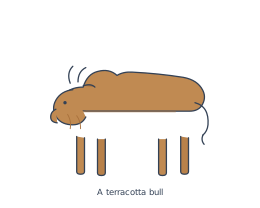
- Bull representations: Seals and terracotta sculptures show bulls, suggesting oxen were used for ploughing.
- Plough models: Terracotta plough models have been found at Cholistan and Banawali (Haryana).
- Ploughed field at Kalibangan: At Kalibangan (Rajasthan), from the Early Harappan period, a field was found with two sets of furrows at right angles to each other. This indicates that two different crops were grown together in the same field (mixed cropping).
Irrigation and Water Management
Most Harappan sites are in semi-arid lands, so irrigation was likely needed.
- Canals: Traces of canals have been found at Shortughai (Afghanistan), but not in Punjab or Sind. It is possible ancient canals silted up long ago.
- Wells: Water drawn from wells was probably used for irrigation.
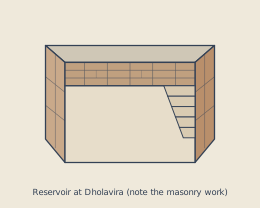
- Reservoirs: At Dholavira (Gujarat), large water reservoirs were found, possibly used to store water for agriculture.
Harvesting Tools
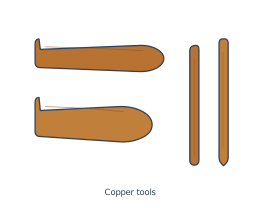
- Archaeologists debate whether Harappans used stone blades set in wooden handles or metal tools (like copper) for harvesting. Copper tools have been found (Fig. 1.4), but their exact use is uncertain.
Food Processing: Grinding Equipment
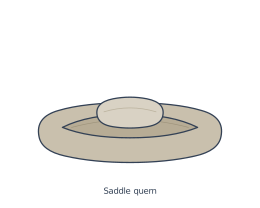
Processing grain required grinding stones. The main type found is the saddle quern.
- Saddle quern: A large, roughly made stone with a convex base (set in earth or mud to prevent rocking). Two types existed:
- For grain: A smaller stone was pushed or rolled to and fro on the quern.
- For spices/herbs (curry stones): A second stone was used as a pounder, creating a cavity in the nether stone.
Key Formulas and Quantitative Results
There are no explicit formulas or equations in this section. The key quantitative result is the geometric arrangement of furrows at Kalibangan:
- Furrow arrangement: Two sets of furrows at right angles to each other.
- This implies the angle between the two furrow directions is . …
Drawn by us to help you understand the concept clearly, and verified to make sure it's accurate. For exams, practice from your NCERT textbook's own diagram.
What Figure 1.3 Shows
The figure is a photograph of a terracotta bull — a small, baked clay model of a bull. It is a single object, not a map or diagram. The bull is shown in a standing pose, with a hump on its back (typical of the zebu or humped bull common in South Asia). Its horns, ears, and legs are clearly modelled, and the surface is plain, unglazed terracotta (reddish-brown). There are no labels, arrows, or other annotations on the image itself.
What It Teaches About Harappan Agriculture
This figure is placed in the section on agricultural technologies (Section 2.1). Its purpose is to provide visual evidence for the use of bulls in Harappan farming. The textbook text explains:
- Bulls were known — the terracotta model, along with bull representations on seals, shows that the Harappans were familiar with this animal.
- Oxen for ploughing — archaeologists infer that oxen (castrated bulls) were used to pull ploughs, because:
- Terracotta plough models have been found at sites in Cholistan and Banawali.
- A ploughed field with two sets of furrows at right angles was discovered at Kalibangan (Early Harappan level), suggesting two crops were grown together — a practice that requires ploughing.
Thus, the terracotta bull is not just an art object; it is a clue that helps reconstruct how Harappans prepared land for agriculture. The figure supports the argument that animal-drawn ploughing was practised, even though direct evidence of ploughs or fields is rare.
Key Takeaway for Exams …
Drawn by us to help you understand the concept clearly, and verified to make sure it's accurate. For exams, practice from your NCERT textbook's own diagram.
Figure 1.4 is a photograph of several copper tools recovered from Harappan sites. The image shows a collection of distinct metal objects, each shaped for a specific function. The tools are arranged in a single frame, likely against a plain background, to allow clear comparison of their forms.
What the figure depicts:
- Axes and adzes: Broad, flat blades with a curved cutting edge, designed to be hafted onto wooden handles. These were used for woodworking, felling trees, and shaping timber.
- Chisels: Narrower, rod-like tools with a sharp, straight edge at one end. They were used for carving, engraving, or splitting materials.
- Knives or daggers: Thin, pointed blades with a sharp edge along one or both sides. Some may have had a tang (a projecting piece) for fitting into a handle.
- Spearheads or arrowheads: Pointed, leaf-shaped or triangular pieces, often with a central ridge for strength. These were likely used for hunting or warfare.
- Sickles or harvesting blades: Curved, crescent-shaped tools with a sharp inner edge. These are the most relevant to the textbook’s discussion of harvesting.
What the figure teaches about the topic:
The image directly addresses the question posed in the section: “Did the Harappans use stone blades set in wooden handles or did they use metal tools for harvesting?” The presence of copper sickles in the figure provides clear evidence that metal tools were available and used for cutting crops. However, the photograph also shows a variety of other copper implements, indicating that metalworking was a well-developed craft, not limited to agriculture.
The figure reinforces that copper was a key material for Harappan technology. The tools are not merely decorative; they show signs of use (wear, resharpening). Their shapes are functional and specialised, suggesting that Harappan artisans understood the properties of copper (malleable, can be hardened by hammering) and designed tools for specific tasks. …
Drawn by us to help you understand the concept clearly, and verified to make sure it's accurate. For exams, practice from your NCERT textbook's own diagram.
What Figure 1.5 Shows
The figure is a photograph of a stone-masonry water reservoir at the Harappan site of Dholavira, located in present-day Gujarat. The image focuses on the reservoir's carefully built walls, which are made of dressed stone blocks laid in a neat, stepped pattern. The walls are straight and well-constructed, indicating deliberate engineering for water storage. The reservoir itself appears as a large, rectangular or square depression, now empty of water, with the stonework clearly visible along its sides. There are no people, tools, or other objects in the image — the emphasis is entirely on the masonry structure and its design.
What It Teaches About the Harappan Civilisation
This figure is placed in the textbook section on agricultural technologies (Section 2.1). It illustrates how the Harappans adapted to semi-arid environments — most Harappan sites were in dry regions where irrigation was necessary. While canals have been found only at Shortughai (Afghanistan), and wells were likely used elsewhere, the Dholavira reservoir shows a third method of water management: storing rainwater or runoff in large, stone-lined tanks.
The masonry work is a key detail — it shows that the Harappans had advanced stone-cutting and construction skills, and that they invested significant labour in building durable water storage systems. This reservoir was probably used to store water for agriculture, especially during dry periods. The figure thus provides direct archaeological evidence for water conservation techniques in the Harappan civilisation, complementing the textual discussion of ploughs, furrows, and harvesting tools.
Connection to the Broader Topic …
Drawn by us to help you understand the concept clearly, and verified to make sure it's accurate. For exams, practice from your NCERT textbook's own diagram.
What the Saddle Quern Shows
The figure depicts a saddle quern, a stone tool used for grinding grain in the Harappan civilisation. It consists of two parts:
- A large, flat or slightly concave base stone (the quern itself), made of hard, gritty rock like igneous stone or sandstone. Its base is often convex, meaning it would rock unless set into earth or mud.
- A second, smaller stone (the handstone or roller) that was pushed or rolled back and forth across the base stone to crush grain.
The illustration likely shows the base stone with a worn, shallow depression in the centre, formed by repeated grinding. The smaller stone may be shown resting on or beside it. No labels, arrows, or additional objects are described — the focus is solely on the quern and its grinding action.
What It Teaches About Harappan Life
This simple tool reveals several key insights:
- Food processing: Saddle querns were the primary means of grinding cereals like wheat and barley. Their widespread presence at sites like Mohenjodaro indicates that grain was a staple food.
- Technology and labour: The quern required manual effort — a person would kneel and push the handstone to and fro. This was labour-intensive, suggesting that food preparation was a daily, time-consuming task.
- Craft and material use: The querns were “roughly made” from locally available hard stone, showing that Harappans selected durable materials for repeated use. The convex base was deliberately shaped to be set into the ground for stability. …
Processing food required grinding equipment and vessels for mixing, blending and cooking, made of stone, metal and terracotta. One of the earliest excavation reports on Mohenjodaro described the saddle querns found there:
Saddle querns … are found in considerable numbers … and they seem to have been the only means in use for grinding cereals. As a rule, they were roughly made of hard, gritty, igneous rock or sandstone and mostly show signs of hard usage. As their bases are usually convex, they must have been set in the earth or in mud to prevent their rocking. Two main types have been found: those on which another smaller stone was pushed or rolled to and fro, and others with which a second stone was used as a pounder, eventually making a large cavity in the nether stone. Querns of the former type were probably used solely for grain; the second type possibly only for pounding herbs and spices for making curries. In fact, stones of this latter type are dubbed "curry stones" by our workmen and our cook asked for the loan of one from the museum for use in the kitchen.
— Ernest Mackay, Further Excavations at Mohenjodaro, 1937 …