History · Ch 1 — Bricks, Beads and Bones — The Harappan Civilisation
The End of the Civilisation
The End of the Civilisation
The End of the Harappan Civilisation
The decline of the Harappan Civilisation was not a sudden event but a gradual process that unfolded over several centuries. By c. 1800 BCE, most major Mature Harappan sites, especially in regions like Cholistan, had been abandoned. This was not a uniform collapse; instead, it involved a transformation of material culture and a shift in population.
What Changed?
- Abandonment of Core Areas: Settlements in Cholistan and the Indus heartland were deserted.
- Population Shift: People moved into new areas like Gujarat, Haryana, and western Uttar Pradesh.
- Disappearance of Hallmarks: The distinctive artefacts that defined the Mature Harappan phase vanished:
- Standardised weights and seals
- Specialised beads
- The Harappan script
- Long-distance trade networks
- Craft specialisation
- Decline in Material Quality: Fewer materials were used to make fewer things. House construction techniques deteriorated, and large public structures (like the Great Bath) were no longer built.
- Ruralisation: The overall pattern of artefacts and settlements points to a rural way of life. This later phase is called the "Late Harappan" or "successor cultures".
Why Did It Happen? Theories and Debates
Several explanations have been proposed, but no single cause explains the collapse of the entire civilisation.
1. Environmental and Economic Causes
These may have affected specific settlements but do not account for the civilisation-wide decline:
- Climatic change (e.g., reduced rainfall)
- Deforestation
- Excessive floods
- Shifting or drying up of rivers (e.g., the Ghaggar-Hakra)
- Overuse of the landscape (overgrazing, soil salinisation)
2. The End of the Harappan State
The most compelling evidence points to the collapse of a unifying political authority—the Harappan state. This is inferred from the disappearance of:
- Seals (used for administration and trade)
- The script (a tool of the elite)
- Standardised weights and measures
- Distinctive pottery and beads
- Planned cities
The shift from a standardised weight system to local weights is a key indicator of the breakdown of centralised control.
3. The "Aryan Invasion" Theory (Now Rejected)
- R.E.M. Wheeler (1947): Correlated the discovery of 16 skeletons at Mohenjodaro with the Rigvedic god Indra, who is called puramdara ("fort-destroyer"). He argued that the Harappan civilisation was destroyed by invading "Aryans."
- George Dales (1960s): Re-examined the skeletal evidence and found:
- The skeletons did not belong to the same period.
- There was no destruction level, no extensive burning, and no evidence of a final defence of the citadel.
- The bones suggested "sloppy burials," not a massacre.
- Conclusion: The "massacre" theory was based on flawed interpretation. The skeletons were likely from different times and were not victims of a single invasion.
4. Archaeogenetic Evidence from Rakhigarhi (2019)
Recent DNA analysis of skeletal remains from Rakhigarhi (the largest Harappan site, 550 hectares in Haryana) has provided powerful new evidence:
- Indigenous Origins: The Harappans are the indigenous people of the region, with genetic roots going back to 10,000 BCE. …
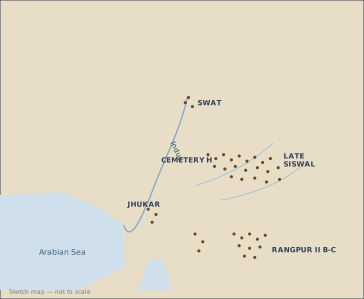
What Map 4 Shows
Map 4 is a sketch map (not to scale) that illustrates the Late Harappan phase (c. 1900–1300 BCE) and the successor cultures that emerged after the decline of the Mature Harappan civilisation. It focuses on the regional shift in settlement patterns — from the core areas of the Indus valley and Cholistan to new regions.
Key Labels and Locations
- SWAT – A region in the northwest (modern Khyber Pakhtunkhwa, Pakistan), associated with a Late Harappan/successor culture.
- LATE SISWAL – A site in Haryana (India), representing a Late Harappan occupation.
- CEMETERY H – A cemetery site at Harappa (Punjab, Pakistan), named after a distinctive pottery style (Cemetery H culture) that replaced the earlier Harappan pottery.
- RANGPUR II B-C – A site in Gujarat (India), where the Late Harappan phase is divided into sub-periods (II B and II C), showing a shift in material culture.
- JHUKAR – A site in Sindh (Pakistan), associated with the Jhukar culture, a successor to the Mature Harappan in the lower Indus region.
What the Map Shows About the Topic
- Geographical spread: The map traces the Arabian Sea coastline and the Indus River as reference points. The labelled sites are distributed across the Indus valley, Gujarat, Haryana, and the northwest frontier — indicating that Late Harappan occupation was not confined to the old Mature Harappan heartland (like Cholistan or Mohenjodaro).
- Regional shift: The textbook text explains that by c. 1800 BCE, most Mature Harappan sites in Cholistan were abandoned, while new settlements expanded into Gujarat, Haryana, and western Uttar Pradesh. Map 4 visually confirms this: sites like Rangpur II B-C (Gujarat) and Late Siswal (Haryana) are in these new areas.
- Successor cultures: The labels (SWAT, Cemetery H, Jhukar, etc.) represent distinct regional cultures that emerged after the collapse of the unified Harappan state. They show localised material culture — different pottery styles, burial practices, and fewer trade goods — as described in the text: “disappearance of weights, seals, special beads… writing, long-distance trade, and craft specialisation also disappeared.”
- No single centre: Unlike Mature Harappan maps (which show large cities like Harappa, Mohenjodaro, and Dholavira), Map 4 has no major urban centres. Instead, it shows a scatter of smaller, rural settlements — reflecting the “rural way of life” mentioned in the textbook.
What the Map Teaches
- Decline is not disappearance: The Harappan civilisation did not vanish overnight. Instead, it transformed into regional successor cultures, each with its own adaptations.
- Environmental and economic factors: The shift to Gujarat and Haryana suggests that river drying, floods, or deforestation (as listed in the text) may have pushed people to more reliable environments. …
Did an invasion end the Harappan civilisation? Successive scholars read the same evidence very differently.
Deadman Lane is a narrow alley, varying from 3 to 6 feet in width … At the point where the lane turns westward, part of a skull and the bones of the thorax and upper arm of an adult were discovered, all in very friable condition, at a depth of 4 ft 2 in. The body lay on its back diagonally across the lane. Fifteen inches to the west were a few fragments of a tiny skull. It is to these remains that the lane owes its name.
— John Marshall, Mohenjodaro and the Indus Civilisation, 1931
In 1947, R.E.M. Wheeler tried to correlate this evidence with the Rigveda:
The Rigveda mentions pur, meaning rampart, fort or stronghold. Indra, the Aryan war-god is called puramdara, the fort-destroyer. … Here we have a highly evolved civilisation of essentially non-Aryan type, now known to have employed massive fortifications … its ultimate extinction is more likely to have been completed by deliberate and large-scale destruction. … On circumstantial evidence, Indra stands accused.
— R.E.M. Wheeler, "Harappa 1946", Ancient India, 1947
In the 1960s, George Dales questioned the "massacre":
Whereas a couple of them definitely seem to indicate a slaughter, … the bulk of the bones were found in contexts suggesting burials of the sloppiest and most irreverent nature. There is no destruction level covering the latest period of the city, no sign of extensive burning, no bodies of warriors clad in armour and surrounded by the weapons of war. The citadel, the only fortified part of the city, yielded no evidence of a final defence.
— G.F. Dales, "The Mythical Massacre at Mohenjodaro", Expedition, 1964
More recent archaeogenetic research at Rakhigarhi extracted DNA from skeletal remains; its authors conclude the Harappans were the indigenous people of the region, with genetic continuity to today's population and no evidence of large-scale immigration:
— Vasant Shinde et al., "An ancient Harappan genome lacks ancestry from steppe pastoralists or Iranian farmers", Cell, 179(3), 2019 …