Biology · Ch 8 — Respiration and Circulation
Blood pressure (B.P.)
Blood pressure (B.P.)
Blood pressure is the pressure exerted by circulating blood against the walls of blood vessels, most often measured in the arteries using an instrument called a sphygmomanometer.
Arterial Blood Pressure : Pressure exerted by blood on the wall of an artery is arterial blood pressure. Two values are recorded: systolic pressure, the pressure on the arterial wall during ventricular contraction (about 120 mmHg in a healthy adult), and diastolic pressure, the pressure during ventricular relaxation (about 80 mmHg). Blood pressure is written as systolic/diastolic — 120/80 mmHg — and the gap between the two, normally about 40 mmHg, is called the pulse pressure.
B P = SP / DP = 120/80 mmHg
Blood pressure itself is shaped by several interacting factors. Cardiac output (normally about 5 litres/minute) has a direct relationship with systolic pressure — the more blood pumped per minute, the higher the pressure. Peripheral resistance depends on the diameter of blood vessels: vasoconstrictors like vasopressin (ADH) narrow arterioles and capillaries, raising peripheral resistance and therefore blood pressure, while vasodilation lowers it. Blood volume matters directly — losing blood, as in an accident, lowers blood volume and therefore blood pressure. Blood pressure rises with blood viscosity, with the total length of the blood vessels involved, and with venous return (the amount of blood brought back to the heart via the veins per unit time). It also rises with age, as blood vessels become less elastic over time, and is influenced by gender (women generally run slightly lower than men before menopause, but their hypertension risk rises after menopause), sleep, emotional state, exercise and anxiety.
Think about it
Why are obese persons prone to hypertension?
Internet my friend
Surf the internet for video-clips of angiography, angioplasty and by-pass surgery. Gather more information about these medical procedures.
Think about it
- Why does the heart-recipient have to rely upon a life-time supply of immunosuppressants?
- Why does the transplanted heart beat at a higher rate than normal?
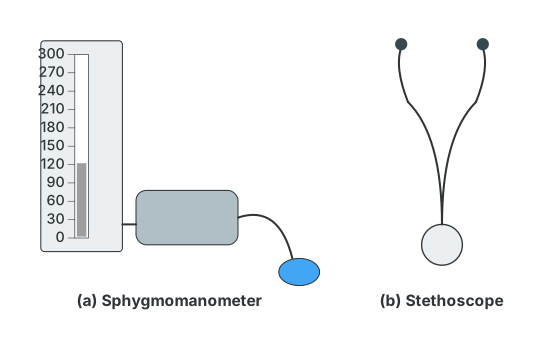
Measurement of blood pressure : A sphygmomanometer measures this by way of an inflatable rubber cuff, wrapped in cloth, connected on one side by tubing to a mercury manometer and on the other to a rubber bulb. With the patient lying down and the instrument held at heart level, the cuff is wrapped around the upper arm and inflated until it fully blocks the brachial artery; the pressure is then slowly released, and the point where the first pulsatile (Korotkoff) sound is heard through a stethoscope marks the systolic pressure, while the point where the sound disappears again (because blood flow has become smooth) marks the diastolic pressure.
Drawn by us to help you understand the concept clearly, and verified to make sure it's accurate. For exams, practice from your textbook's own diagram.
What this figure shows. Two instrument diagrams shown together. Panel (a) is the sphygmomanometer — an inflatable cuff wrapped in cloth, connected by rubber tubing on one side to a mercury-filled manometer that reads out the pressure, and on the other side to a rubber bulb used to pump air into the cuff. Panel (b) is the stethoscope, with its chest-piece for picking up sound placed against the skin over the artery and its tubing running up to earpieces, used alongside the cuff to listen for the pulsatile Korotkoff sounds tha …
Hypertension : Blood pressure below about 90/60 mmHg is called hypotension, and above about 140/90 mmHg is called hypertension, with readings of 180/120 mmHg or higher considered dangerous, risking damage to the heart, brain and kidneys. Persistently high blood pressure forces the heart to work harder to pump, which can cause angina pectoris — chest pain from reduced blood supply to the heart muscle — and can progress to myocardial infarction; it also raises the risk of brain haemorrhage, since brain arteries are less protected by surrounding tissue than arteries elsewhere, and can cause kidney failure through damage to the kidneys' blood supply.
Coronary Artery Disease (CAD) : It is also known as atherosclerosis; in this disease calcium, fat, cholesterol and fibrous tissue build up inside the vessels supplying the heart muscle, narrowing their lumen.
Angina Pectoris : Angina pectoris is typically caused by this narrowing (atherosclerosis) or by general hardening of the arteries (arteriosclerosis), producing severe chest pain and heaviness that can spread to the neck, jaw, left arm and left shoulder, usually during exertion when the heart's oxygen demand outstrips its blood supply.
Angiography : Where a blockage is found (located by X-ray imaging of the heart's vessels, called angiography), it can be treated by angioplasty (inserting a stent at the blockage site to hold the vessel open) or by bypass surgery (routing blood around the blocked section using a piece of vein or artery taken from elsewhere in the body, such as the leg). …