Biology · Ch 8 — Respiration and Circulation
Organs of Respiratory Exchange
Organs of Respiratory Exchange
Respiratory exchange is a simple physical process. For efficient gaseous exchange the respiratory surface should have the following features:
a. It should have a large surface area.
b. It should be thin, highly vascular and permeable, to allow the exchange of gases.
c. It should be moist.
Gaseous exchange in plants : The shape and structure of plants facilitate gaseous exchange by diffusion. A terrestrial flowering plant is riddled with interconnected air spaces running through its stem, leaf and root tissue. In the leaf and young stem, oxygen diffuses in and carbon dioxide and water vapour diffuse out through small pores called stomata; in the root, oxygen dissolves into the film of moisture around root cells in aerated soil and enters by simple diffusion. Woody plants have an outer bark that is largely impermeable, so gas exchange there is concentrated at small breaks in the bark called lenticels.
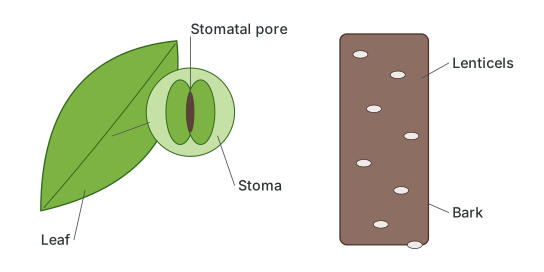
Drawn by us to help you understand the concept clearly, and verified to make sure it's accurate. For exams, practice from your textbook's own diagram.
What this figure shows. A two-part illustration of how a terrestrial flowering plant exchanges gases without any dedicated respiratory organ. One part magnifies a leaf's surface to show a stoma (plural stomata) — a small pore flanked by guard cells opening into the leaf's internal air spaces, through which oxygen diffuses in and carbon dioxide and water vapour diffuse out. The other part shows a woody stem in cross-section with its outer bark, dotted with small raised breaks called lenticels, which let gases pass through t …
Curiosity Box
- What are the main features of a respiratory surface?
- Which are the parts of a plant that help in the process of gaseous exchange?
Respiration in Animals : Animals show far more variety, because as body organization gets more complex and animals move from water onto land, the demands on a respiratory surface change. The simplest animals (protists, sponges, coelenterates) exchange gases straight across the plasma membrane in an aquatic environment. Flatworms, many annelids (earthworm, nereis, leech) and amphibians like the frog add a moist general body surface to the plasma membrane, working in water or damp conditions. Once animals move fully onto land and grow larger and more active, simple surface diffusion is not enough, and specialised respiratory organs appear: insects use a network of tracheal tubes opening to the outside through spiracles; arachnids like spiders and scorpions use book lungs; the aquatic arthropod Limulus uses book gills; amphibian larvae, salamanders and newts use external gills; fish use internal gills; and reptiles, birds and mammals — including humans — use lungs. Turtles are a partial exception, additionally using their cloaca for gas exchange while submerged. In the more complex, larger …
| Organism | Habitat | Respiratory surface/organ |
|---|---|---|
| Protists, Sponges and Coelenterates | Aquatic | Plasma membrane |
| Flatworms like Planaria, Annelids (earthworm, nereis, leech), amphibians (frog) | Aquatic or semiaquatic | Plasma membrane, general body surface (moist skin) |
| Insects | Terrestrial | Tracheal tubes and spiracles |
| Arachnids like spiders and scorpions | Terrestrial | Book lungs |
| Limulus (Arthropod) | Aquatic | Book gills |
| Amphibian tadpoles of frog, salamanders and newts | Aquatic | External gills |