Biology · Ch 8 — Respiration and Circulation
Circulation in animals
Circulation in animals
Use your brain power
What is the co-relationship between the activeness of an organism and the complexity of its transport system?
In higher animals the circulation is carried out by special fluids - blood and lymph.
Blood vascular system : Higher animals from Annelida to Chordata have a special circulating fluid, the blood, which is pumped to the tissues by the heart through the blood vessels.
Types of blood vascular system :
1. Open circulation : Blood is pumped out of the heart but is not confined to vessels for its whole journey — instead it empties into open body cavities called haemocoels, where the internal organs sit directly bathed in blood, and material is exchanged straight between the blood and the surrounding cells and tissues. Because the fluid moves through open spaces rather than a sealed pipe network, it flows at low pressure, and it usually lacks a respiratory pigment like haemoglobin, so it does not carry respiratory gases the way vertebrate blood does. Arthropods (such as the cockroach, studied in Class 11) and molluscs are the classic examples of open circulation.
Observe and Discuss
Observe the diagram (the dorsal heart of a cockroach with its chambers and the ostia along the abdomen) and give appropriate labels.
2. Closed circulation : Blood is confined within a continuous network of blood vessels for its entire circuit and never directly touches the body's cells and tissues — any exchange of material happens indirectly, through an intermediate fluid called lymph. Because the fluid stays inside a sealed system of vessels, it flows at high pressure, and it does carry a respiratory pigment such as haemoglobin, letting it transport respiratory gases efficiently. Closed circulation is found in all vertebrates and in the higher molluscs and annelids.
The closed circulation can be divided into two main types: single and double circulation.
Single circulation : passes through the heart only once per cycle: deoxygenated blood is pumped from the two-chambered heart to the gills, where it is oxygenated, and this oxygenated blood then travels on to the rest of the body, gets deoxygenated there, and returns directly to the heart to start the next cycle — since the fish heart only ever handles deoxygenated blood, it is sometimes called a 'venous heart'.
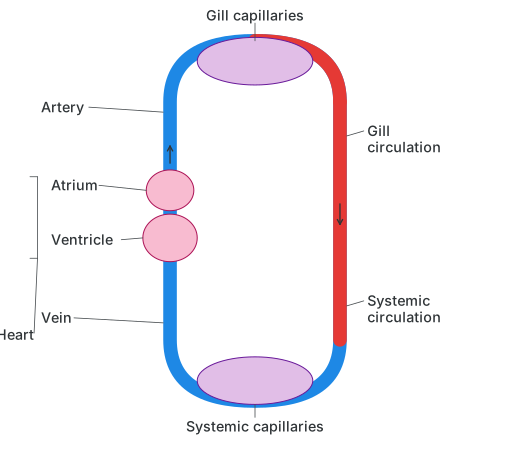
Drawn by us to help you understand the concept clearly, and verified to make sure it's accurate. For exams, practice from your textbook's own diagram.
What this figure shows. A simplified loop diagram of the fish circulatory plan. A two-chambered heart (one atrium, one ventricle) pumps deoxygenated blood forward through an artery to the gill capillaries, where it picks up oxygen; this oxygenated blood then travels on to the systemic capillaries supplying the rest of the body, where it gives up oxygen again, and returns as deoxygenated blood through a vein straight back to the heart — passing through the heart only once in the whole circuit, wh …
…
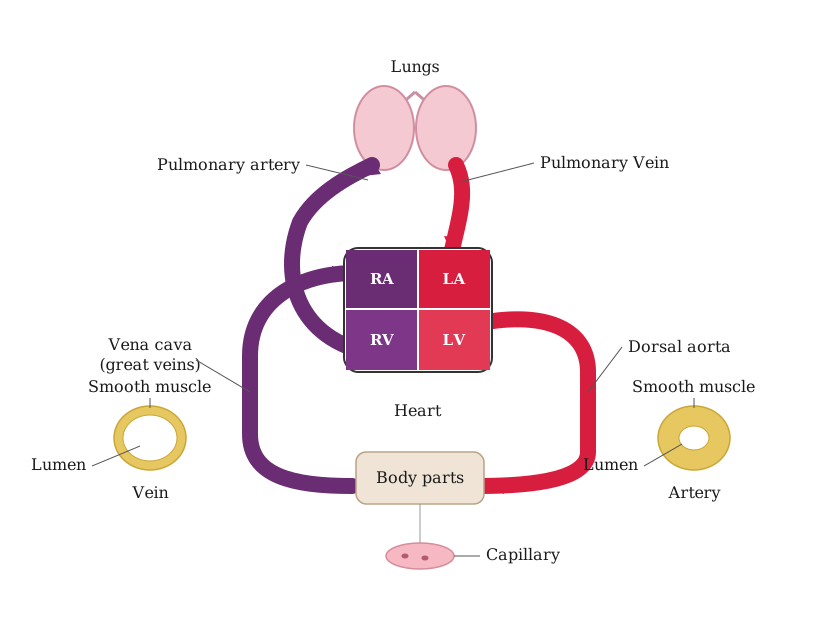
Drawn by us to help you understand the concept clearly, and verified to make sure it's accurate. For exams, practice from your textbook's own diagram.
What this figure shows. A loop diagram of the mammalian/bird circulatory plan, built around a four-chambered heart. The right atrium and right ventricle send deoxygenated blood out through the pulmonary artery to the lungs, where it is oxygenated and returned by the pulmonary veins to the left atrium — this loop is the pulmonary circulation. The left ventricle then pumps that oxygenated blood out through the dorsal aorta to the body's organs, which return it as deoxygenated blood via the superior and inferior vena cava to the right atrium — this second loop is the systemic circulation. Because blood passes through the heart twice in one full …