Biology · Ch 8 — Respiration and Circulation
Blood vessels
Blood vessels
Blood travels through three distinct kinds of vessel — arteries, veins and capillaries — each structurally suited to a different job.
Arteries : Arteries carry blood away from the heart to organs throughout the body, branching progressively into smaller arterioles and finally into capillaries; except for the pulmonary artery, which carries deoxygenated blood to the lungs, arteries normally carry oxygenated blood. Most arteries run deep within the body, though a few — the radial, brachial and femoral arteries among them — lie close enough to the surface to be felt. In cross-section, an artery wall has three layers: the outermost tunica externa (or tunica adventitia), a thick, tough layer of collagen fibres; the tunica media, made of smooth muscle and elastic fibres, which is thick enough to make the arterial wall pulsate with each heartbeat; and the innermost tunica interna (or intima), a single layer of flat, compact endothelial cells lining the lumen, with a tessellated pattern visible around its margin. Arteries have no internal valves, and blood inside them flows rapidly and under high pressure.
Veins : Veins carry blood from the organs back toward the heart, formed as capillaries around an organ rejoin into progressively larger vessels; except for the pulmonary veins, veins normally carry deoxygenated blood.
Portal vein : A portal vein, such as the hepatic portal vein, is an exception to the usual vein pattern — it starts as capillaries in one organ and then breaks up into capillaries again in an intermediate organ (the liver, in this case) before finally reaching the heart. Histologically, veins have the same three layers as arteries (tunica externa, media, interna), but the tunica media is comparatively much thinner, the lumen is wider, and — unlike arteries — veins have internal valves at regular intervals to stop blood flowing backward, since blood in veins moves at low pressure and needs help staying on course, particularly against gravity in the limbs.
Capillary : Capillaries are the finest blood vessels, forming dense networks around tissues; their wall is just a single, stretchable layer of flat squamous epithelium on a single basement membrane, with no muscular layer at all, since their whole purpose is exchange rather than transport. Small pores or fenestrae in the capillary wall let white blood cells squeeze through and out into the tissue, again by diapedesis, and blood moves through capillaries under comparatively high pressure relative to their thin walls.
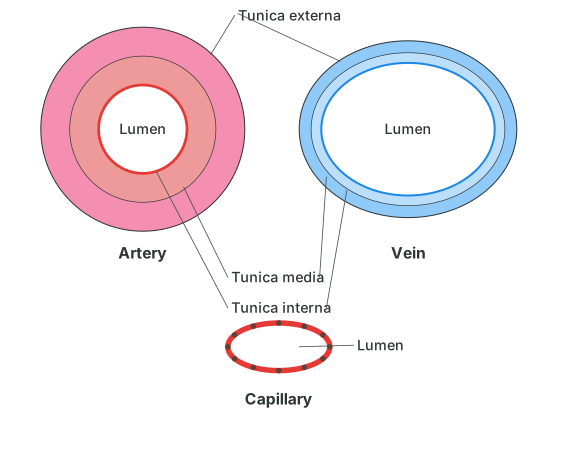
Drawn by us to help you understand the concept clearly, and verified to make sure it's accurate. For exams, practice from your textbook's own diagram.
What this figure shows. Three transverse-section diagrams placed side by side for comparison. The artery is shown with a narrow lumen and a thick wall built of three layers — the tough outer tunica externa, a thick muscular and elastic tunica media, and a thin inner tunica interna — giving it a pulsatile, high-pressure wall. The vein is shown with a wider, more oval lumen, the same three layers but a noticeably thinner tunica media, and internal valves. The capillary is shown as just a single thin layer of flat (squamous) cells wrapped around a very narrow lumen, …
…
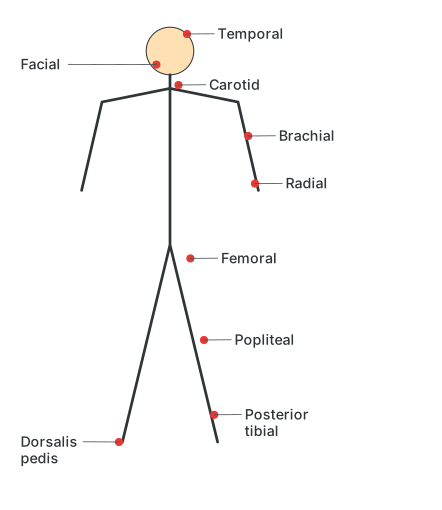
Drawn by us to help you understand the concept clearly, and verified to make sure it's accurate. For exams, practice from your textbook's own diagram.
What this figure shows. An outline of the human body with dots marking every point where an artery runs close enough to the surface for its pulse to be felt by pressing a finger against it — including the temporal and facial arteries near the head, the carotid artery in the neck, the brachial and radial arteries in the arm and wrist, the femoral artery in the groin, the popliteal artery behind the knee, and the posterio …