Biology · Ch 8 — Respiration and Circulation
Transportation in living organisms
Transportation in living organisms
Can you recall?
Which type of circulation is present in the cockroach? How is it different from that of humans?
Every living organism, whether made of a single cell or many, has to constantly exchange material with its surroundings and move material between different parts of its own body — taking in what it needs and pushing out the wastes it generates. How this transport happens depends heavily on how large and complex the organism is. Where the body's surface area is large relative to its volume and the distance between different parts is very small, simple diffusion and active transport between cells are enough, without any dedicated transport system; this covers transport between the cells of many small or simply built organisms. Within a single cell, transport is often helped along by cyclosis, the streaming movement of cytoplasm seen in organisms like Paramoecium and Amoeba, in root-hair cells of many plants, and in the white blood cells of animals.
Once a body plan gets more complex, simple diffusion between cells is no longer enough, and organisms develop intermediate solutions before a full circulatory system appears. In sponges and coelenterates, the surrounding water itself is drawn through channels and body cavities to reach the cells directly. In flatworms, there is parenchymal circulation — fluid moving through the loosely packed tissue (parenchyma) that fills the body, rather than through dedicated vessels. In roundworms, there are no blood vessels at all; instead the body fluid filling the body cavity is kept moving around the internal organs (viscera) by the contraction of the body wall muscles. Because none of the sponge, flatworm or roundworm solutions send fluid through internal vessels, and material is exchanged directly with cells or tissue, this whole category is described as extracellular transport, distinct from the intracellular transport (cyclosis) that moves material within a single cell.
Observe and Discuss
Observe the diagram and discuss the process with your friends.
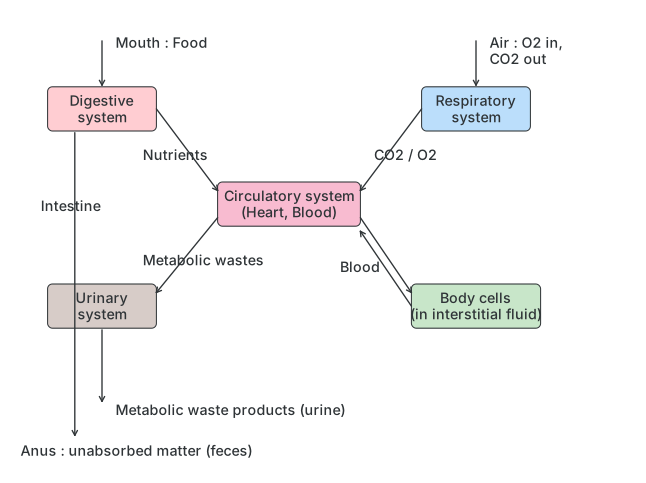
Drawn by us to help you understand the concept clearly, and verified to make sure it's accurate. For exams, practice from your textbook's own diagram.
What this figure shows. An unlabelled overview diagram that ties together the digestive, respiratory, urinary and circulatory systems around a central set of body cells bathed in interstitial fluid. It shows food entering via the mouth and being absorbed by the digestive system into the blood (with unabsorbed matter leaving as faeces via the anus), oxygen and carbon dioxide being exchanged with the respiratory system, and metabolic waste being filtered out through the urinary system as urine — with the heart and blood of the circulatory system acting as the common carrier that links all three systems to the body ce …
…