Q.Explain the structure of DNA.
You're viewing a preview — the full solution, concept, methods & PYQ mapping are locked.
Start your 14-day free trial to unlock the full solution →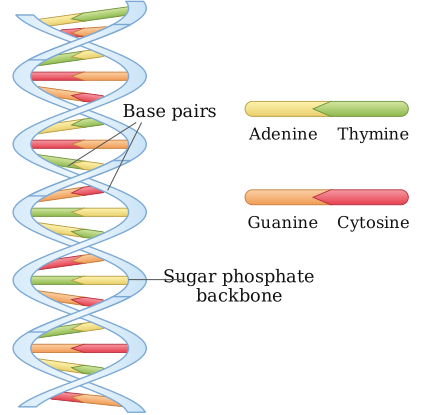
DNA is a right-handed double helix of two antiparallel, complementary polynucleotide chains held together by specific hydrogen-bonded base pairing.
The structure of DNA (deoxyribonucleic acid) was worked out by James Watson and Francis Crick in 1953, based substantially on Rosalind Franklin's and Maurice Wilkins' X-ray diffraction data, and is described by the following features:
-
Double helix of two strands: DNA consists of two long polynucleotide chains coiled around a common central axis to form a right-handed double helix, resembling a twisted ladder.
-
Antiparallel orientation: The two strands run in opposite directions -- if one strand is oriented 5' to 3', the complementary strand runs 3' to 5' alongside it. This antiparallel arrangement is essential for correct base pairing and for the mechanisms of replication and transcription.
-
Sugar-phosphate backbone: Each strand is a polymer of nucleotides. A nucleotide consists of a deoxyribose (5-carbon) sugar, a phosphate group, and a nitrogenous base. Successive sugars in a strand are linked to one another through phosphodiester bonds between the 3'-carbon of one sugar and the 5'-carbon of the next, forming the sugar-phosphate backbone that runs along the outside of the helix; the backbone is uniform, while the bases attached to each sugar vary and carry the genetic information.
-
Nitrogenous bases: Four bases occur in DNA -- two purines, adenine (A) and guanine (G) (double-ringed structures), and two pyrimidines, cytosine (C) and thymine (T) (single-ringed structures). The bases project inward from the backbone, toward the axis of the helix.
-
Complementary base pairing: The two strands are held together by hydrogen bonds between specific pairs of bases facing each other across the helix -- adenine always pairs with thymine (A=T) through two hydrogen bonds, and guanine always pairs with cytosine (G-C) through three hydrogen bonds. Because a purine always pairs with a pyrimidine, the diameter of the helix remains uniform along its length. This specific pairing (Chargaff's rule: the amount of A equals the amount of T, and the amount of G equals the amount of C) also means that the base sequence of one strand automatically determines the sequence of the other, the basis of DNA replication.
-
Helical dimensions: The two strands are coiled such that one complete turn of the helix measures about 3.4 nm and contains about 10 base pairs; the rise (distance) between successive base pairs is about 0.34 nm, and the overall diameter of the double helix is about 2 nm.
…
Unlock everything free for 14 days
- Full step-by-step solutions
- Concept-first explanations
- Methods, shortcuts & mistakes
- PYQ mapping + timed mock tests
Full access for 14 days. No credit card required.