Q.Explain replication of bacteriophage with the help of a suitable diagram.
You're viewing a preview — the full solution, concept, methods & PYQ mapping are locked.
Start your 14-day free trial to unlock the full solution →In the lytic cycle, a bacteriophage: adsorbs onto a specific bacterial surface receptor via its tail fibres; injects its DNA into the host cell, leaving the protein coat outside; uses host machinery to replicate its D...
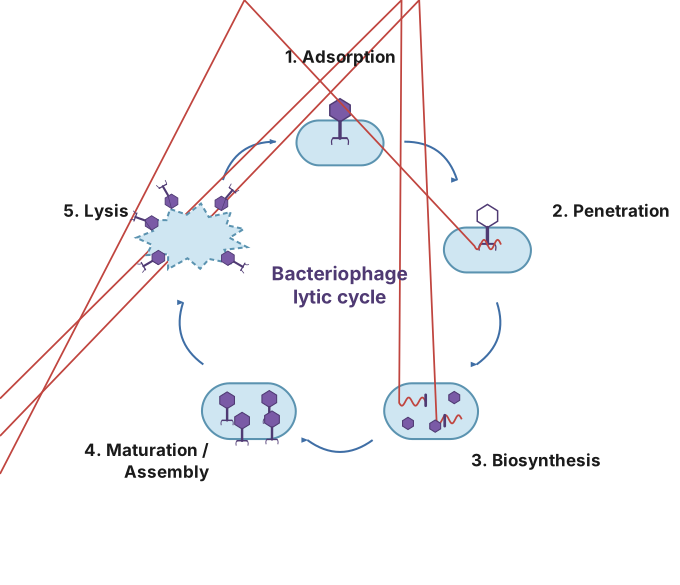
The lytic cycle of a bacteriophage proceeds through adsorption, injection, replication, assembly and lysis to release new virus particles.
Bacteriophages (viruses that infect bacteria, e.g. the T-even phages) typically replicate through the lytic cycle, which occurs in five stages. (1) Adsorption: the phage's tail fibres recognize and specifically attach to complementary receptor molecules on the outer surface of the host bacterium. (2) Penetration: the phage's tail sheath contracts, driving a hollow tube through the bacterial cell wall/membrane, through which the phage's DNA is injected into the host cytoplasm — the protein coat (capsid) remains outside and takes no further part. (3) Biosynthesis (replication): the injected phage DNA takes over the host's metabolic and biosynthetic machinery, degrading the host's own DNA and directing the host ribosomes and enzymes to replicate multiple copies of phage DNA and synthesise the various structural phage proteins (head/capsid, tail, tail fibres). (4) Maturation (assembly): the newly synthesised phage DNA molecules are packaged inside newly assembled protein capsids, and tails and tail fibres are attached, forming complete, infective progeny phage particles. (5) Lysis and release: a phage-coded enzyme (l …
Unlock everything free for 14 days
- Full step-by-step solutions
- Concept-first explanations
- Methods, shortcuts & mistakes
- PYQ mapping + timed mock tests
Full access for 14 days. No credit card required.