Q.(a) Draw a suitable diagram of replication of eukaryotic DNA and label any three parts.
5'GCCACAUGGAGAUGACGACAAAAUUUUACUAGAAAA3'
You're viewing a preview — the full solution, concept, methods & PYQ mapping are locked.
Start your 14-day free trial to unlock the full solution →A diagram of the eukaryotic replication fork showing the two separating parental strands, leading strand (continuous synthesis), lagging strand (Okazaki fragments), DNA polymerase, helicase and ligase. 8 amino acids.
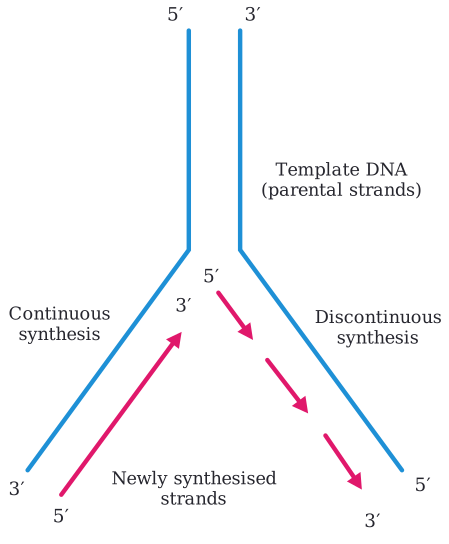
The eukaryotic replication fork shows semi-discontinuous synthesis (leading + lagging strand); translating the given mRNA from its first AUG to the stop codon gives an 8-amino-acid polypeptide.
(a) A diagram of eukaryotic DNA replication should show the DNA double helix opening up at a replication fork, with helicase unwinding the parental double strand, single-strand binding proteins stabilising the separated strands, and DNA polymerase synthesising new complementary strands using each parental strand as template. Because DNA polymerase can only synthesise in the 5' to 3' direction, one new strand (the leading strand) is synthesised continuously in the direction of fork movement, while the other (the lagging strand) is synthesised discontinuously as short Okazaki fragments in the direction away from the fork, later joined together by DNA ligase. Any three of these labelled parts - e.g. replication fork, leading strand, lagging strand/Okazaki fragments, helicase, DNA polymerase, DNA ligase - would be acceptable labe …
Unlock everything free for 14 days
- Full step-by-step solutions
- Concept-first explanations
- Methods, shortcuts & mistakes
- PYQ mapping + timed mock tests
Full access for 14 days. No credit card required.