Physics · Ch 10 — Magnetic Fields due to Electric Current
Toroid
Toroid
A TOROID can be thought of as a solenoid of finite length, bent around and joined into a closed, hollow, ring- or tube-shaped structure -- similar in overall shape to a pressurised inner tube inside a vehicle's tyre (Fig. 10.26). Unlike an open-ended solenoid, a toroid has no ends at all, and this closed-loop geometry has an important consequence: the field lines inside the tube form CONCENTRIC CIRCLES that run all the way around the toroid's own central circular axis, never spreading out to "leak" outside the winding the way a solenoid's field does near its open ends.
To find the field along this central axis using Ampere's law, choose a CIRCULAR Amperian loop of radius , running along the toroid's own central circular axis, all the way around the ring, so that it threads through every SINGLE one of the turns of winding as it goes (i.e. the loop encircles the current-carrying wire separate times, once per turn). By the toroid's symmetry, is constant in magnitude and directed exactly tangent to this circular loop everywhere along it (exactly as it was for the single straight wire of Section 10.15), so
(the net enclosed current is , since the loop threads the SAME current , separate times, once through each turn of the winding). Solving,
…
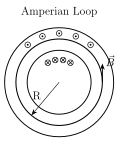
Drawn by us to help you understand the concept clearly, and verified to make sure it's accurate. For exams, practice from your textbook's own diagram.
What this figure shows. A toroid -- a helical coil of wire bent around into a closed, doughnut-like ring shape -- is shown in cross-section, with its many individual turns of winding visible around the tube's circular cross-section. A circular Amperian loop of radius R is drawn running along the toroid's own CENTRAL circular axis (i.e. through the middle of the tube, all the way around the ring, threading through every one of the N turns of winding as it goes), illustrating exactly the loop choice used in the surrounding Ampere's-law derivation -- this loop necessarily encircles the full current (curren …