Q.Identify the chromosomal aberrations: (i), (ii), (iii),
You're viewing a preview — the full solution, concept, methods & PYQ mapping are locked.
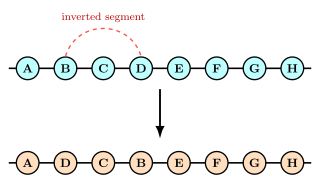
Start your 14-day free trial to unlock the full solution →Deletion — segments D and E are lost. Translocation — segments A-B are replaced by new segments P-Q-R from a non-homologous chromosome. Duplication — segment C-D is repeated. Inversion — the order of segments B-C-D is...
The four rearrangements shown are deletion, translocation, duplication and inversion respectively.
Structural chromosomal aberrations change the arrangement of genes on a chromosome without necessarily changing chromosome number. (i) When a broken segment of a chromosome (here D-E) is lost entirely so the resulting chromosome has fewer segments (A-B-C-F-G-H), this is a deletion (deficiency).
(ii) When a segment (A-B) of one chromosome is exchanged for a segment (P-Q-R) originating from a different, non-homologous chromosome, this is a translocation. …
Unlock everything free for 14 days
- Full step-by-step solutions
- Concept-first explanations
- Methods, shortcuts & mistakes
- PYQ mapping + timed mock tests
Full access for 14 days. No credit card required.