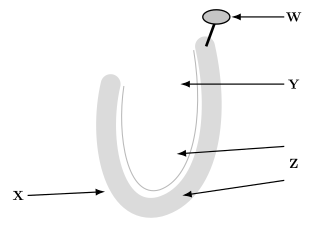
Q.Name the parts W, X, Y and Z from the following figure:
You're viewing a preview — the full solution, concept, methods & PYQ mapping are locked.
Start your 14-day free trial to unlock the full solution →The figure shows an anatropous ovule, whose characteristic inverted, hook-shaped form places the funicle, micropyle, integuments and chalaza in this arrangement.
The figure described — a curved, hook/'U'-shaped structure with a small stalked disc at the top — is consistent with a mature anatropous ovule, the commonest ovule type in flowering plants, in which the body of the ovule becomes completely inverted (180°) during development so that it lies alongside its stalk. In such an ovule: the funicle (W), the stalk that originally attached the ovule to the placenta, becomes fused along most of the length of the ovule body (forming a ridge called the raphe) and is seen at the top as the point of attachment; the micropyle (X) is the small pore, lying close to the funicle/hilum at the base of the curve, through which the pollen tube enters to effect fertilization; the integument (Y), the protective layer(s) enveloping the central nucellus, forms the thick inner wall of the curved structure; and the chalaza (Z) is the basal region, opposite the micropyle, where the integuments, the nucellus, and the funicle all meet and merge, and towards which the two converging arrows point in the middle/lower curved region of the figure. Together these parts equip the ovule for its role in housing the embryo sac …
Unlock everything free for 14 days
- Full step-by-step solutions
- Concept-first explanations
- Methods, shortcuts & mistakes
- PYQ mapping + timed mock tests
Full access for 14 days. No credit card required.