Q.Sketch and label V.S. of mature anatropous ovule.
You're viewing a preview — the full solution, concept, methods & PYQ mapping are locked.
Start your 14-day free trial to unlock the full solution →The anatropous ovule is inverted 180 degrees, bringing the micropyle close to the funicle and creating the raphe ridge along one side.
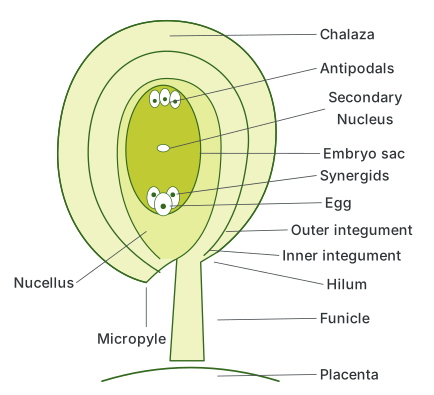
An anatropous ovule is the most common ovule type in angiosperms. During its development the ovule body becomes completely inverted (turned through 180 degrees) relative to its stalk, so that the body of the ovule comes to lie parallel and fused alongside the funicle. This fusion of the funicle with the ovule body creates a longitudinal ridge on one side called the raphe. Because of this inversion, the micropyle (the small pore in the integuments through which the pollen tube enters) ends up lying very close to the hilum (the point where the funicle was originally attached), at the same end of the ovule, while the chalaza — the basal region where the integuments, nucellus and funicle all merge — lies at the opposite end from the micropyle. The ovule body itself consists of two protective integuments (outer and inner) surrounding a central mass of nucellus tissue, within which lies the embryo sac (female gametophyte), containing the egg apparatus (one egg cell flanked by two synergids) at the micropylar end, three antipodal cells at the chalazal end, and two polar nuclei in the centre. A labelled sketch should show: funicle, hilum, raphe, micropyle, chalaza, integument(s), nucellus, and embryo sac with its egg a …
Unlock everything free for 14 days
- Full step-by-step solutions
- Concept-first explanations
- Methods, shortcuts & mistakes
- PYQ mapping + timed mock tests
Full access for 14 days. No credit card required.