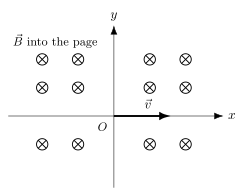
Q.A proton enters a perpendicular uniform magnetic field B at the origin along the positive x axis with a velocity v, as shown in the figure. It will then follow which of the following paths? (A) It will continue to move along the positive x axis. (B) It will move along a curved path, bending towards the positive y axis. (C) It will move along a curved path, bending towards the negative y axis. (D) It will move along a sinusoidal path along the positive x axis. [Whether the field B is directed into or out of the plane of the paper is shown only in the source figure and flips the sign of the bending direction, so it cannot be answered without it.]
You're viewing a preview — the full solution, concept, methods & PYQ mapping are locked.
Start your 14-day free trial to unlock the full solution →Concept understanding — Magnetic Force on a Moving Charge
A charge moving with velocity through a region containing a magnetic field experiences a force , with magnitude where is the angle between and . Combined with the ordinary electrostatic force whenever an electric field is also present, the total force is the Lorentz force, .
Because a vector cross product is always perpendicular to both of the vectors that produce it, the magnetic force is always perpendicular to the particle's velocity. This has a striking consequence: the magnetic force does no work on the particle (work requires a force component along the direction of motion, and here that component is always zero), so it can never change the particle's speed or kinetic energy -- only the direction it is travelling in. A magnetic field also exerts zero force on a stationary charge, and zero force on a charge moving exactly parallel to the field, since in both cases the relevant angle in makes the force vanish. …
Unlock everything free for 14 days
- Full step-by-step solutions
- Concept-first explanations
- Methods, shortcuts & mistakes
- PYQ mapping + timed mock tests
Full access for 14 days. No credit card required.