Q.What is 'photophosphorylation'? Describe non-cyclic photo-phosphorylation with schematic representation. Give its significance. OR What is 'RNA'? Explain different types of non-genetic RNA with diagrams and functions.
You're viewing a preview — the full solution, concept, methods & PYQ mapping are locked.
Start your 14-day free trial to unlock the full solution →Photophosphorylation is light-driven ATP synthesis during photosynthesis.
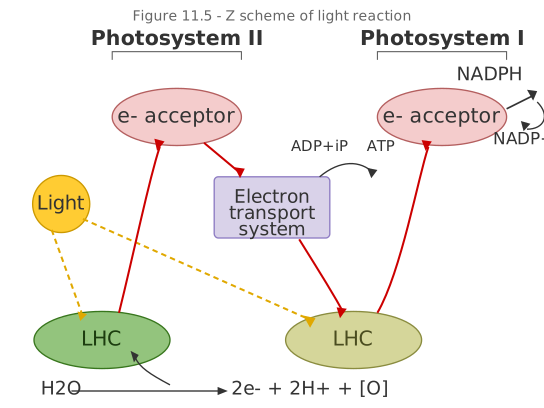
Non-cyclic photophosphorylation couples both photosystems to generate ATP, NADPH and O2, fuelling the Calvin cycle. OR: mRNA, tRNA and rRNA are the three non-genetic RNAs that together carry out translation.
Photophosphorylation / non-cyclic pathway: Photophosphorylation is the process by which ATP is synthesised using the energy of light-excited electrons during the light reactions of photosynthesis. In non-cyclic photophosphorylation, both Photosystem II and Photosystem I act together in a linear sequence, known as the Z-scheme. Light striking Photosystem II excites and ejects an electron, which passes down an electron transport chain (through plastoquinone, the cytochrome b6f complex, and plastocyanin) to Photosystem I; this electron flow pumps protons across the thylakoid membrane, creating an electrochemical gradient that ATP synthase uses to generate ATP (chemiosmosis). The electron lost from PS II is continually replaced by electrons obtained from the photolysis of water — water molecules are split into protons, electrons and molecular oxygen, with the O2 released as a by-product. Meanwhile, at Photosystem I, light re-excites the electron received from PS II, and it is passed via ferredoxin to the enzyme NADP+ reductase, which reduces NADP+ to NADPH. Overall, the non-cyclic pathway produces ATP, NADPH, and O2 in a single, one-way (non-cyclic) flow of electrons from water to NADP+. Significance: the ATP and NADPH generated are the two essential energy/reducing-power currencies used to drive the Calvin cycle (dark reactions), where atmospheric CO2 is fixed and reduced to carbohydrate; the O2 released as a by-product of water splitting is also the primary source of atmospheric oxygen sustaining aerobic respiration in nearly all living organisms. …
Unlock everything free for 14 days
- Full step-by-step solutions
- Concept-first explanations
- Methods, shortcuts & mistakes
- PYQ mapping + timed mock tests
Full access for 14 days. No credit card required.