5.1 · Q8
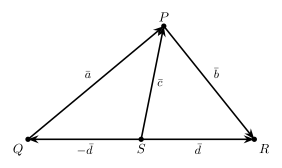
Q.In the figure 5.34 (triangle PQR with along the left side, along the right side, and S the midpoint of QR with , ) express and in terms of and .
Maharashtra MsbshseTextbookSubjectiveImportance★★★★★est
4% · 8/215 Questions
You're viewing a preview — the full solution, concept, methods & PYQ mapping are locked.
Start your 14-day free trial to unlock the full solution →Take as the origin for position vectors. Since , has position vector
. Since , has position vector .
The figure marks and with equal magnitude and
opposite sign, which means is equidistant from and along the segment , i.e. is the
midpoint of . So has position vector
…
Unlock everything free for 14 days
- Full step-by-step solutions
- Concept-first explanations
- Methods, shortcuts & mistakes
- PYQ mapping + timed mock tests
Full access for 14 days. No credit card required.