Q.Give the schematic representation of TCA cycle.
You're viewing a preview — the full solution, concept, methods & PYQ mapping are locked.
Start your 14-day free trial to unlock the full solution →Acetyl-CoA (2C) + oxaloacetate (4C) -> citrate (6C) -> isocitrate -> alpha-ketoglutarate (releases CO2, NADH) -> succinyl-CoA (releases CO2, NADH, forms ATP/GTP) -> succinate (FADH2) -> fumarate -> malate -> oxaloacet...
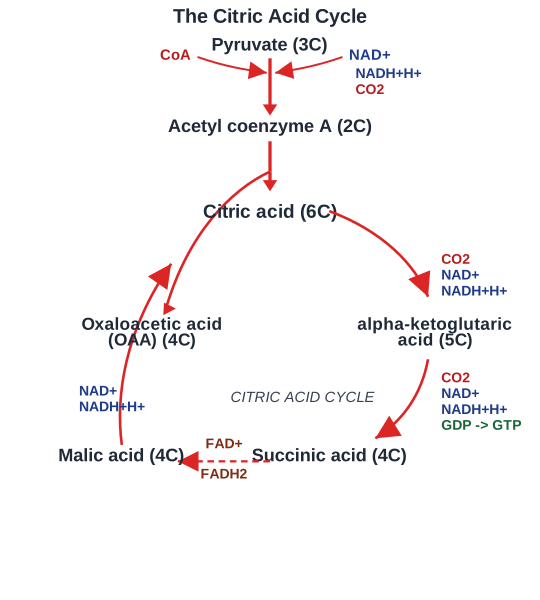
The TCA cycle oxidises acetyl-CoA in a repeating series of steps that regenerate oxaloacetate while releasing CO2 and reduced coenzymes.
The tricarboxylic acid (TCA/Krebs) cycle occurs in the mitochondrial matrix. Acetyl-CoA (2 carbons) condenses with oxaloacetate (4 carbons) to form citrate (6 carbons), catalysed by citrate synthase. Citrate is isomerised to isocitrate, which is then oxidatively decarboxylated to alpha-ketoglutarate (5 carbons), releasing one CO2 and reducing NAD+ to NADH. Alpha-ketoglutarate undergoes a second oxidative decarboxylation to succinyl-CoA (4 carbons), releasing a second CO2, generating another NADH, and this high-energy thioester bond is later used for substrate-level phosphorylation, producing one ATP (or GTP). Succinyl-CoA is converted to succinate, during which FAD is reduced to FADH2. Succinate is then oxidised to fumarate, fumarate is hydrated to malate, and finally malate is oxidised back to oxaloacetate, generating one more NADH and completing the cycle so that oxaloacetate is regenerated …
Unlock everything free for 14 days
- Full step-by-step solutions
- Concept-first explanations
- Methods, shortcuts & mistakes
- PYQ mapping + timed mock tests
Full access for 14 days. No credit card required.