Q.What is cardiac cycle? Draw a normal ECG and label it. What do P-wave and QRS complex represent?
You're viewing a preview — the full solution, concept, methods & PYQ mapping are locked.
Start your 14-day free trial to unlock the full solution →The cardiac cycle is the complete sequence of events (mechanical and electrical) occurring in the heart during one heartbeat, comprising atrial systole, ventricular systole, and joint diastole.
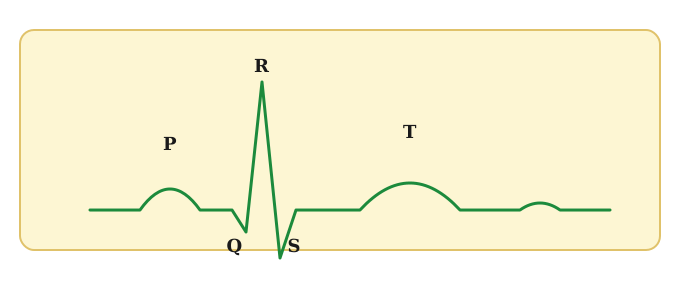
The cardiac cycle is one complete heartbeat sequence (atrial systole → ventricular systole → diastole); on an ECG, the P-wave = atrial depolarization, QRS complex = ventricular depolarization.
The cardiac cycle refers to the complete, repeating sequence of mechanical and electrical events that occur in the heart during a single heartbeat, from the beginning of one heartbeat to the beginning of the next, lasting about 0.8 seconds at a normal resting heart rate. It consists of three main phases: atrial systole (contraction of the atria, pushing blood into the ventricles, lasting about 0.1 s), ventricular systole (contraction of the ventricles, pumping blood into the pulmonary artery and aorta, lasting about 0.3 s), and joint diastole (relaxation of both atria and ventricles simultaneously, during which the chambers passively fill with blood, lasting about 0.4 s).
An electrocardiogram (ECG/EKG) is a graphical record of the electrical activity generated by the heart during each cardiac cycle, and shows a characteristic sequence of waves:
The P-wave is the first small upward deflection, representing depolarization (electrical excitation) spreading through the atrial muscle, which triggers and immediately precedes atrial contraction (atrial systole).
The QRS complex is the sharp, tall spike that follows, representing the rapid depolarization of the ventricular muscle, which triggers ventricular contraction (ventricular systole); it is much larger than the P-wave because the ventricular muscle mass is far greater, and it also masks the (much smaller) electrical signal of atrial repolarization occurring at the same time. …
Unlock everything free for 14 days
- Full step-by-step solutions
- Concept-first explanations
- Methods, shortcuts & mistakes
- PYQ mapping + timed mock tests
Full access for 14 days. No credit card required.